
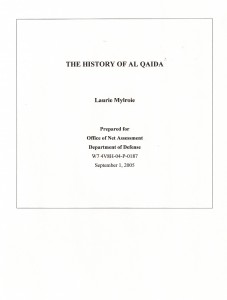
Reference: History of Al Qaeda by Dr. Laurie Mylroi
Categories: DoD
Steele 3-Page Review of the Work
Phi Beta Iota: This document, in three parts (over 300 pages, Part I is the Executive Summary and front matter) is dated 1 September 2005 and was prepared for the Office of Net Assessment in the Department of Defense (US). It has not gotten the visibility it merits. It is very unusual for a living person to have a Wikipedia page, regardless of whether one agrees with the author on varied points, this marks her as a person of influence whose views must be considered.
Dec 13

Some amplifying notes to this excellent review of Mylori’s flawed 2004 paper:
CIA set up its “virtual station” under Michael Scheuer as an operational not intelligence office. As such it developed no intelligence information on its only target Osama bin Laden (aka Usama bin Ladin), but implausibly attempted to develop a means to kill or capture him without knowing anything about him or his group. CIA’s Counter-Terrorism Center (CTC) suffered from much the same problem. As a result, as Mylori suggests, on the eve of the 9/11 tragedy CIA was almost entirely ignorant of the nature of al Qaeda and bin Laden. She is wrong though that the entire IC shared this ignorance.
In 1998 a joint project was initiated by the technical intelligence agencies (NGA/NSA) to identify the financial structure supporting what was then miscalled the “UBL Network” (now called the “al Qaeda Movement”). To understand how the bin Laden financial system worked it was first necessary to understand bin Laden’s structural organization. Again as Mylori notes, it became apparent that bin Laden’s strength was principally ideological and financial and he had a very small group of body guards, advisors, and other functionaries serving him. His financial support system was based on his family’s wealth (the bin Laden family to this day is patronized by the Saudi Royal family), contributions from adherents to his ideological appeal, and, apparently, the drug trade. Prior to 9/11 the bin Laden group received funds via the Hawalla System (traditional Islamic banking), regular electronic funds transfers via Western Style commercial banks (such as the Habbib Bank of Pakistan), and payoffs from drug traffickers (if some journalists are to be believed). Oddly enough the intelligence branch of the U.S. Treasury Department also and independently figured out bin Laden’s multi-layered financing system, but it was considered too complicated to brief anyone on so the work has remained buried (this is scuttlebutt from an acquaintance). Prior to 9/11 then some parts of the IC did have some understanding of al Qaeda, even if CIA, as inter-agency meetings demonstrated in the pre-9/11 days, was clueless.
Mylori makes an important and valid point about the relationship of Pakistan’s Bluchistan Province and the bin Laden Group. The Baluchis have long sought autonomy from Pakistan and appear always ready to fight to attain it. Quetta the province’s capital is the headquarters of a number of Pshutun-Baluchi trucking companies whose chief source of revenue is illicit drug transporting to the port of Karachi. At the time of the East African bombings of the U.S. Embassies, bin Laden’s compound was located near Khandahar Afghanistan just over the border (in frontier terms) from Quetta. Baluchi involvement in bin Laden’s group makes perfect sense. As in everything else about the al Qaeda phenomenon, some elements of the IC knew about the Baluchi-bin Laden connection and some did not.
Mylori, however, is guilty of a leap of logic in use of telephone records to prove Iraqi sponsorship of 9/11 attacks. The analysis of dialing patterns and phone connectivity is the absence of actual content of calls is a tricky business. A number of factors have to be taken into account that she ignored. It is true as she notes number and duration of calls are important factors (if nothing else to exclude wrong numbers), but so are number and duration calls from the called number to the calling number. Also if available the dialing pattern of the called number, and most importantly, what number was most often called after receiving the phone call (in Mylroi’s example from London to Basher, Iraq). Besides this sort of factual information, some analytic thought would suggest that if Iraq were indeed sponsoring a terrorist attack against the U.S. it would make better sense to use agents abroad to support and guide the terrorists so as to give the Iraqi government at least some deniability. Also how likely is it that any member of a terrorist group would take it upon himself to make “hundreds of phone calls” to his state sponsors?
Incidentally the last I heard CIA was still clueless, trying to decide if al Qaeda ought to be worked as a transnational or regional problem!
[...] Office of Net Assessment, a DOD spokesman tells us. The study, which is dated September 2005, was posted on an intelligence blog last [...]
[...] Office of Net Assessment, a DOD spokesman tells us. The study, which is dated September 2005, was posted on an intelligence blog last [...]