

Chuck Spinney is still the best “real” engineer in this town–almost everyone else is staggering after fifty years of government-specification cost-plus engineering. Also, as Chuck explores in the piece on Complexity to Avoid Accountability is Expensive we in the “requirements” business are as much to blame–Service connivance with complexity has killed acquisition from both a financial inputs and a war-fighting relevance outcome point of view. The Services have forgotten the basics of requirements definition and multi-mission interoperability and supportability.
The Marine Corps Intelligence Center (MCIC) was created by General Al Gray, USMC (Ret), then Commandant of the Marine Corps, for three reasons:
1. Intelligence support to constabulary and expeditionary operations from the three major services was abysmal to non-existent.
2. Intelligence support to the Service level planners and programmers striving to interact with other Services, the Unified Commands, and the Joint Staff was non-existent–this was the case with respect to policy, acquisition, and operations. The cluster-feel over Haiti and the total inadequacy of our 24-48 hour response tells us nothing has changed, in part because we still cannot do a “come as you are” joint inter-agency anything.
3. The Marine Corps understood long before everyone else that the consolidation of many tactical intelligence billets and dollars at the unified command level was a huge mistake, ultimately stripping essential tactical capabilities from those that needed it most–direct support to Fleet Marine Force (FMF) units unable to get what they need from theater or national sources has been a major success story for MCIC.
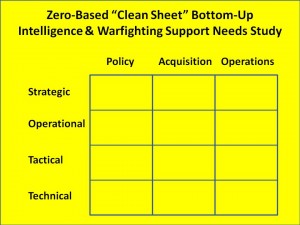 In my view, acquisition is like sailboat racing–you win or lose the race the minute you nail down your requirements (or in the case of sailing, finish assuring hull perfection before putting the boat in the water).
If the requirements are wrong or inadequate or worse, exaggerated, the plans and programs will stink, the budget will be unexecutable, and what comes out the other end will not only be an ugly baby, it will be a comatose baby. There are many examples, but the Striker comes to mind as a classic failure of intelligence all around–including a failure to plan for long-haul liftability.
Across the board, multi-disciplinary inter-domain machine-speed processing is non-existent. This is one of two sucking chest wounds in defense intelligence today, the other one is the resistance to fully embrace what could be accomplished with Multinational Engagement on an Open Source Intelligence (OSINT) foundation. We need to launch a lifeboat that I absolutely guarantee will establish a benchmark for the classified disciplines that will save tens of billions of dollars in less than a decade.
As the Secretary of Defense goes about conceptualizing defense acquisition reform, we hope that he remembers intelligence preparation of the battlefield. Without an understanding of the totality and diversity of the threat spectrum, one cannot craft a strategy–especially if one hopes to rely on multinational partners for critical elements of support in executing that strategy. Without a strategy one cannot devise a multi-level joint-coalition-whole of government capabilities box, and the dollar actions that follow.
Acquisition reform has to start with defense intelligence reform across all disciplines, but particularly in the sub-functional area of requirements definition. Our standard was set in New Orleans in WWII by the US Marine Corps and Andrew Jackson Higgins. That standard is achievable today. All it takes is integrity. St.
See Also:
Journal: Complexity to Avoid Accountability is Expensive
Search: Intelligence Preparation of the Battlefield
Journal: The Intelligence War Not Fought
Journal: Strategy versus Secrecy
2009 Perhaps We Should Have Shouted: A Twenty-Year Restrospective
Search: Strategic Analytic Model
1990 Expeditionary Environment Analytic Model
Journal: A Tale of Two Flying Pigs
Worth a Look: Book Reviews on Innovation
Worth a Look: Book Reviews on Leadership for Epoch B
Worth a Look: Book Reviews on Peace
Worth a Look: Book Reviews on Stabilization & Reconstruction
Worth a Look: Book Reviews on Strategy
Worth a Look: Book Reviews on Technology & Web 2.0 to 4.0


