
UPDATE: A colleague from within asked us to highlight this quote with the observation that neither the US IC nor DoD have any clue how to execute. We agree. Both lack leadership with vision and multinational panache; they simply do not know what they do not know because they have both wasted the last 21 years refusing to listen or learn.
P.23. They must embrace open-source, population-centric information as the lifeblood of their analytical work. They must open their doors to anyone who is willing to exchange information, including Afghans and NGOs as well as the U.S. military and its allies. As General Martin E. Dempsey, commander of the U.S. Army Training and Doctrine Command, recently stated, “…[T]he best information, the most important intelligence, and the context that provides the best understanding come from the bottom up, not from the top down.”
The Cold War notion that open-source information is “second class” is a dangerous, outmoded cliché. Lieutenant General Samuel V. Wilson, former director of the Defense Intelligence Agency, captured it perfectly: “Ninety percent of intelligence comes from open sources. The other 10 percent, the clandestine work, is just the more dramatic.
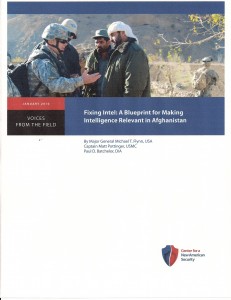
News Story with Links: Spies Like Us: Top U.S. Intel Officer Says Spooks Could Learn From Journos
Good News: Some good people in the field have finally re-invented half the wheel–the company-level bottom-up half. Unfortunately they have absolutely no idea what can be gotten from the rest of the world (non US citizens without clearances); they are jammed into a legacy system that demands at least a SECRET clearance; there is no Multinational Engagement Network that is totally open albeit commercially encrypted, and therefore this is going nowhere. We could fix this on leftover loose-change, but ONLY if DoD intel leadership will accept the iconoclastic multinational solutions that have been in gestation for 21 years.
Bad News: CIA and DIA are still broken and not likely to get fixed anytime soon. The Human Terrain Teams (HTT) are an utter disgrace. DoD commanders still have not figured out Open Source Intelligence (OSINT) and OSINT does not appear in this report, nor does Reach-Back, 24/7 tribally-nuanced on demand web-cam translator services, and on and on and on. Army G-2 is non-existent–Army is simply not trained, equipped, nor organized to do tactical intelligence in small wars. Neither is the Marine Corps, but they adapt better. What is so very tragic is that this is a problem that can be fixed FAST with Multinational Engagement and a proper use of distributed linguistic and cultural assets. All it needs is an internationalist mind-set, which no one now serving in DIA or CIA actually can muster. All of the pathologies we have been writing about since 1988 are to be found in Afghanistan, and none of the solutions that many, many authors have written about for the last 21 years are even on the table.
See also:
Journal: Anthropology 101–Not Being Listened To
Journal: Weak Signal on Afghanistan
Journal: Afghanistan as Corruption Squared
Journal: Demise of Obama in Afghanistan Part II
Journal: Integrity, Afghanistan, & The White House
Journal: Afghanistan = Viet-Nam, National Security Council Remains “Like a Moron”
Journal: Military says linguists can’t keep up in Afghanistan
Search: Intelligence and the Viet-Nam War
Still Broken–A Recruit’s Inside Account of Intelligence Failures, from Baghdad to the Pentagon
Beyond Repair: The Decline and Fall of the CIA
The Shadow Factory–The Ultra-Secret NSA from 9/11 to the Eavesdropping on America
Journal: National Intelligence or National Goat-F…?
Journal: The Demise of US Intelligence Qua Brains
Journal: Director of National Intelligence Alleges….
Review: Descent into Chaos–The United States and the Failure of Nation Building in Pakistan, Afghanistan, and Central Asia


