
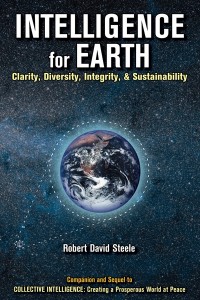
Book: INTELLIGENCE FOR EARTH–Final

Categories: Books (OSS/EIN)

Amazon Page

The book has gone to the printer.  This is final.

Full formal covers and flaps going to printer

Covers and flaps without spine for local print wire bound

Full Text of the book (High Resolution 7.69MB)

Full Text of Book in Four Parts

Part I (1.18MB)

Part II (1.16MB)

Part III (1.60MB)

Part IV (1.21MB)

Book’s Amazon Page ($29.95) Ships from Amazon around 15 March.

Bookmark and Share
Mar 8

15 Responses to “Book: INTELLIGENCE FOR EARTH–Final”

  1. Retired Reader says:

    Judging by its table of contents this book represents a culmination to date of Steele’s thinking on intelligence structure and operations. Identifying what he conceives as the ten major threats to humanity as the bases for designing a global intelligence system is exactly the way to begin. What intrigued me was the concept of an “open source decision support information network.” Presumably Steele’s regional intelligence centers that he has postulated in other books and his “open source intelligence support cells” would form the nodes of this network. It is not clear from just the table of contents, but presumably this information network would ride on the Global (Telecommunications) Network and be supported by a sophisticated and robust information system with distributed data bases and information management sub-systems. My only quarrel with this whole concept is that I do not believe the UN is capable of operating or using a sophisticated intelligence system. It is a fine forum for trying to influence world opinion, but its membership is too divisive with too many conflicting agendas for it to be effective governing body. I would try to promote this intelligence system among a smaller group such as the G8, EU, or African Union. It would have a better chance of demonstrating its effectiveness.

  2. Thanks for the thoughts. Ultimately the World Brain is one in which every single INDIVIDUAL has their own voice and vote, all decisions at all levels are consensual, and we achieve “non-zero” win-win for everyone–to include voluntary birth control combined with an active appreciation for diversity and assuring the perpetuation of cultures and languages that are dying out at a frightening rate today (3000 languages down from 5000 is one tid-bit I recollect.

    The UN may not be smart enough, even with China and India pressing for the case, so I am also turning my attention to Africa and South America, seeking to engage those regional organizations in using Open Everything to “shut down” predatory immoral and usually illegal behavior by both internal and extrernal parties.

    Utlimately one small area (e.g. Vermont) is going to get it right, the world will see how easy it is to create prosperity and peace at one third the price of war and theft, and presto, we move to a new level of conscious evolution. Millions have worked toward this for over fifty years, the book, and my work, is but a spark to the gunpowder others have put into place…lousy metaphor, but you get the idea.

  3. Wage Slave says:

    Retired Reader raises an important problem, and the way Steele answers it might be elaborated in the book. The problem is how current institutions relate to the open intelligence system. Steele needs to worry a little more about how that relationship could fail, and what the options are. If you just slap the system together with the UN, as a conventional UN program, that may kill it or misdirect it. I don’t know the answer, but it may have something to do with setting the system up as an arm of ‘the public’ that relates to specific international and regional institutions (not to national governments) as a ‘board’. Boards are supposed to be responsible, wise, informed, and sympathetic with the goals of the institution. They also organize and discipline themselves and relate directly to decision makers on strategic problems. They are funded by the organizations they serve but are not controlled by those institutions. There is a literature on public boards, which I know nothing about. Maybe such boards never work, but it is at least a model for creating both the linkage and the distance needed from the institutions that are served. If the institutional managers do not heed their boards, they lose legitimacy. The institutions would have to demonstrate that they are hearing what the boards are generating (via the intelligence system) and would be asked to report on issues as the system sees them. (As a practical matter, it would be the system ghost-writing such a report. For example, the OAS would report, in the “Integrity Section” on what it has been doing to control tax evasion via fradulent interstate trade records.

  4. Both comments are VERY helpful. I am adding links to HIGH NOON and A More Secure World as a quick fix. The entire book will be free online with links to all relevant books and web sites throughout (instead of footnotes), with the hard copy intended to be a primer for well-intentioned leaders who are simply out of touch with reality and need to understand how simply a totally open multinational engagement information sharing and sense-making system can both work, and help us achieve a prosperous world at peace.

  5. pinecarr says:

    Retired Reader states “Identifying what he [Robert D. Steele] conceives as the ten major threats to humanity as the bases for designing a global intelligence system is exactly the way to begin.” I couldn’t agree more.

    Given that, and as someone who greatly admires your ability to digest huge amounts of information in your pursuit of truth, I would like to bring “The Crash Course”, by Dr. Chris Martenson, to your attention. It is available free on-line at http://www.chrismartenson.com/crashcourse.

    I think Chris’s 5 year search for the truth -relating to interacting problems in the economy, energy, and environment- complements your search for larger truths, just starting from a different perspective. I also think the knowledge he conveys may contribute additional insights for your assessment of the top threats to humanity.

    For an independent review of the Crash Course by the Huffington Post, see “The Perfect Crash Course on the Economy”, at: http://www.huffingtonpost.com/charles-shaw/the-perfect-crash-course_b_169849.html.

    Both you and Chris have incredible intellects, and demonstrate great integrity, commitment to the truth, and to the betterment of humankind. I think you may find the Crash Course (and his site) interesting.

  6. This is very helpful and precisely the kind of input that I am seeking to attract. Thank you. Will review and integrate.

  7. Retired Reader says:

    Here are some thoughts on this thought producing chapter:
    Information both in its unprocessed form (data) and processed form (knowledge) is an essential driver for any successful individual or institutional enterprise. Yet if it is not managed effectively it can be worthless or even detrimental to success.
    The Information Revolution is a by-product of the digital age and the simultaneous creation of integrated worldwide telecommunications networks (the so-called Global Network). This provides everyone connected to the Global Network with virtually unlimited access to masses of data and herein is the problem. Unverified and unorganized data is worse than useless since it can only produce an inaccurate and confused understanding of reality. To be truly useful information must be transformed into knowledge by a process of organization, collation, research and analysis. Indeed this is exactly what knowledge based enterprises are created to do and most information systems are designed to assist. Information can achieve its potential only as knowledge.
    Many Governments and proprietary enterprises attempt to classify information both as data and knowledge for two principal reasons: to protect the means by which it was collected and the processes used to transform it into knowledge; or to prevent unauthorized persons or institutions from knowing that specific knowledge is available to someone other than its original developer. Unfortunately too often classification has become a cloak to hide incompetence or failure within an organization. Classification can also be used to restrict access to information by rivals since knowledge is truly power. Finally classification of knowledge can be used as a mechanism to protect institutional goals such as preservation of prerogatives, budgets, staffing, and organizational structure.
    Information whether as data or knowledge is in itself neutral, but good thing. It has however been distorted and misused for very evil purposes at times even if sometimes for benevolent ends.

  8. I learned, a government expense, that the secret world cannot cope with the data load. Jim Bamford has it right in the last sentence of his book Body of Secrets–after trillions of dollars NSA still cannot replicate the capabilities, weight, and energy efficiency of a single human brain.

    For me the “magic sauce” lies in flipping the system and using humans–mostly volunteer social networks–to do the data entry and data evaluation. Paul Strassmann and others have observed that we use computers backwards–the bulk of their use should be in processing, not collection, and we should be moving more power to desktop analytics, something I and others looked at in the 1980′s in the now defunct and never very useful Advanced Information Processing and Analysis Steering Group (AIPASG).

    The IC has too much money and too little imaginationo while also being so clogged with 1950′s security mind-sets it cannot see the treasure before its eyes: human intelligence in all languages all the time.

  9. [...] among the eight tribes in the respective nations).  Both concepts are explored in the new book, INTELLIGENCE FOR EARTH and in two DoD briefings that are also relevant to the QDR. var addthis_pub = ''; var [...]

  10. Retired Reader says:

    This is an extremely important chapter, collection and processing are indispensible but often forgotten components of any intelligence process. As Steele has pointed repeatedly, effective processing is one of the key to producing real intelligence. He has made the case that NSA ought to be focused on the developing efficient processing methods as central processing agency for the IC. I would add that processing involves a number of phases designed to transform often unreadable and obscure streams of information into usable bits of recognizable information that then can be processed into intelligence. At the same time there is an ongoing debate over collection strategies. Should collection programs should be designed to collect everything and the results then sifted through by various automated search and retrieval systems? Or should collection platforms and programs be steered by target knowledge and subject expertise to use selection and filtering to collect only what is believed to be relevant material? Steele with his accurate conceptualization of the global threat environment might be partial to the selection and filtering approach.

  11. [...] URL for all of them as they are updated.  This was done in preparation for the final part of INTELLIGENCE FOR EARTH: Clarity, Diversity, Integrity, & Sustainability.  In contrast to the 98 Review categories where books are cross-listed, in this set of “good [...]

  12. [...] Book: INTELLIGENCE FOR EARTH–Part IV Overview Loaded [...]

  13. [...] INTELLIGENCE for EARTH: Clarity, Diversity, Integrity, & Sustainability goes to the printer on the 1st of February 2010.  On the second we start learning Portuguese.  St. [...]

  14. [...] Figure will be in Chapter 26, “Conscious Non-Zero Evolution Local to Global,” of INTELLIGENCE FOR EARTH: Clarity, Diversity, Integrity, & Sustainability (EIN, 2010) var addthis_pub = ''; var addthis_language = 'en';var addthis_options = 'email, [...]


Warning: Unknown: failed to open stream: No such file or directory in Unknown on line 0

Fatal error: Unknown: Failed opening required '/data/16/1/35/61/1850387/user/2008605/cgi-bin/root.ini' (include_path='.:/usr/services/vux/php5/lib/php') in Unknown on line 0