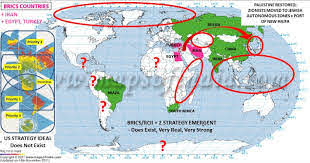
 From Arctic to Arabian Sea and West by Southwest
A Concept for Uniting China, India, Iran, & Russia with Open Source Innovation
Robert David Steele

The truth at any cost lowers all other costs — curated by former US spy Robert David Steele.
From Arctic to Arabian Sea and West by Southwest
A Concept for Uniting China, India, Iran, & Russia with Open Source Innovation
Robert David Steele

How social media gives new voice to Brazil's protests
Street protests continue to rock Brazil and, frustrated by mainstream media coverage, a new group of citizen journalists is using digital tools to tell a different side of the story
EXTRACT
But the battles are not just being waged on the street. Angered by what they see as a misrepresentation of the issues by traditional media, new independent media collectives and networks have emerged over the past year. Armed with smartphones, digital cameras, and apps such as Twitcasting and Twitcam that allow them to broadcast live online, they are presenting their own version of events. Some of them are reaching a huge audience across the country and are now looking to expand their reach internationally.
One such group is the Mídia Ninja, a self-styled loose collective of citizen journalists, which first emerged during last summer's protests. They are keen to present an alternative narrative to the mainstream media by reporting live from the frontline.
 “China Has Good Reason to Help Stabilize Latin American Economies”
Although these alliances will primarily be closer to home, most of Latin America is a naturally ally not only because of its increasing trade and commercial relations with China, but because of its common interest in an international political order that favors respect for national sovereignty and independence over unilateral intervention and military force.
In the last week or so much of the international business press has been focused on the problems of financial stability in developing countries, some of whom have recently become more vulnerable to capital outflows.
The main cause is that investors are trying to get the jump on possible moves by the U.S. Federal Reserve to allow U.S. interest rates to rise, which will draw capital from developing countries and cause their borrowing costs to rise.
Argentina has gotten some of this attention, as it allowed the peso to fall by 15 percent in one day and increased some access for Argentines to dollars on the official market.
Venezuela is not so much affected by these market developments, but is always negatively portrayed in the international media, and more so in the last year since its exchange rate system problems have caused its inflation to rise to an annual rate of 56 percent over the past year.
The two countries face different sets of problems, but they will both likely have to stabilize their exchange rates in order to resolve them.
This is where international help can make a big difference, and there is one country that has both the ability to help and a compelling interest in doing so: China.
China has already helped Venezuela with tens of billions of dollars of loans – much of which has already been repaid – as well as investment.
It has also provided significant lending and investment in Ecuador, Cuba, Brazil, and other countries. But there is more that they could do at this moment.
Continue reading “4th Media: China as Financial Stabilizer for Latin America?”
Government shutdown and Chinese gold
EXTRACT
Gordon Duff first reported in Veterans Today another financial scandal motive for the Repubs wanting to hold up Obama Care. New regulations were going into effect to stop the cross collateralization of insurance company reserves, who are all owned by banks, so they could be market traded. The sums involved were astronomical.
“The Obama Care issue is about ‘funds in management.’ The health insurance industry, through investment banks and hedge funds, accounts for 35% of the entire investment capital of the United States.
This sector has been totally unregulated with, not just individual policyholders but industries and government forced to subsidize a health care Ponzi scheme where in some cases fewer than 3% of policy premiums were paid back in benefits.”
 The America media, like a long chain of administrations, never really seems to understand the South American psyché, in all of its national complexity, nor what is going on there. So there is very little coverage or attention, and what there is trades in stereotypes and shallow commentary. In contrast I think the nations of our Southern Hemisphere, are undergoing an extraordinary transition, which constitutes one of the most interesting geopolitical developments going on. As you read this keep in mind Uruguay's recent legalization of marijuana.
Ecuador’s President Denounces Chevron As ‘Enemy of Our Country’
Agence France-Presse (France)
Continue reading “SchwartzReport: South America Rising + New World Order II Meta-RECAP”
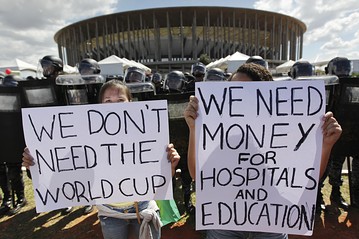
Brazil: The demonstrations are starting to turn violent. The day after the government revoked the transportation fare increases the demonstrations swelled again and engaged in more aggressive clashes with police.
President Dilma Rousseff decided to call off a visit to Japan that was planned for next week. The forthcoming visit by Pope Francis might also have to be rescheduled if the demonstrations continue.
In Rio de Janeiro riot police fired tear gas and rubber bullets at groups of masked young men trying to approach the City Hall late on Thursday. At least 29 people were reported to be injured in the clashes.
Some reports suggest about 300,000 people were taking part in an anti-government rally in the city. One news service reported more than 800,000 people participated in demonstrations in the major Brazilian cities
Comment: The polling agency, Datafolha, published its findings from a poll of the demonstrators in Sao Paulo yesterday. More than half of the demonstrators are under 25. Seventy-seven percent have higher education. Eighty-four percent back no political party, suggesting they do not vote.
The dominant issue for more than half was the fare increase which has been withdrawn. Corruption, a better transportation system, against all politicians and against violence and repression were distant other issues.
What the poll and anecdotal reports indicate is that the beneficiaries of Brazilian prosperity are protesting. The poll found no poor or disadvantaged people and few unemployed among the protestors. Brazil has low unemployment even for workers under age 25. The protestors have no organization or leadership. They gather by cell-phone notification. Expect the demonstrations to expand this weekend and become more violent.
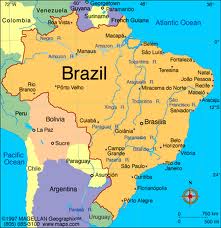
Brazil: The largest anti-government demonstrations in 20 years, according to news analysts, have continued for five days in Sao Paulo, Brasilia, Rio de Janeiro and eight other cities. News reports said 65,000 people demonstrated in Sao Paulo and over 100,000 marched in Rio. Social networking enabled coordinated marches in Sao Paulo, Rio and Belo Horizonte. Most of the demonstrations have been peaceful.
President Dilma Rousseff said in a brief statement, “Peaceful demonstrations are legitimate and part of democracy. It is natural for young people to demonstrate.”
No deaths have been reported. About 200 people have been injured around the country.
Comment: An increase in the cost of public transportation in Sao Paulo sparked the first demonstrations, which flash mob tactics swelled. As the demonstrations spread, demonstrators said they were protesting government corruption, poor economic conditions, criminal violence and lack of public safety, official spending for the Olympics in 2016 and the World Cup in 2014 and rising prices.
The government response has been much more restrained than that of the Turkish government and the violence has been much less. Nevertheless, the phenomenology looks very similar.
The police said they would not intervene to stop the demonstrations provided they did not result in property destructions. A small group of protestors in Rio set a car on fire. The car fire prompted the clash with police, which dominated international media coverage and misrepresented the peaceful nature of the demonstrations.
Continue reading “NIGHTWATCH: Brazil Unravels — Is this an Opportunity for NATO?”
