SchwartzReport: Solar Traps Game Changer — and US Allows Seven Toxic Food Practices Banned in Europe

schwartz reportHere is another potential game changer in the transition to non-carbon energy. More and more breakthroughs are popping up. One can only wonder what it would have been like if we had put the trillions we have spent on war into eliminating carbon energy, and transitioning to energy technologies that were non-polluting.

Inventor Claims Solar Energy Discovery That Is Game-changer
GREG GORDON – Idaho Statesman

This is the difference between the U.S. and European food systems. It is not a pretty picture.

Seven Dangerous Food Practices Banned in Europe But Just Fine in America
TOM PHILPOTT – AlterNet (U.S.)/Mother Jones

Comments Off
May 14

Chuck Spinney: Understanding the Arab Transformation — Political & Economic Harmonization, Not Democratization, Is Core First Step

Chuck Spinney

Chuck Spinney

Below is a very interesting summary of the political tensions among secularism and religion and modernism and tradition in Tunisia.  I think the author, who I do not know but whose writings I have followed, is one of the most knowledgeable observers of the Arab Spring.

Chuck Spinney

Washington Report on Middle East Affairs

April 2013, Pages 41-42

Tunisia in Turmoil:What Next?

By Esam Al-Amin

THE SPARK THAT ignited the Arab Spring over two years ago came from Sidi Bouzid in Tunisia. For 28 days people across the country revolted against the repression and corruption of the 23-year authoritarian regime of Zine El Abidine Ben Ali. Finally, on Jan. 14, 2011 Tunisians celebrated their victory and resilience over tyranny and oppression when Ben Ali fled the country. But if getting rid of the dictator was relatively short and easy, the dismantling of his regime and its corrosive effects on society has proven to be very challenging indeed.

Read the rest of this entry »

Comments Off
May 12

Berto Jongman: Africa Being Plundered — Loses Twice as Much to Corruption as Receives from Donors

Berto Jongman

Berto Jongman

Kofi Annan: Africa plundered by secret mining deals

Tax avoidance, secret mining deals and financial transfers are depriving Africa of the benefits of its resources boom, ex-UN chief Kofi Annan has said.

BBC 10 May 2013

Firms that shift profits to lower tax jurisdictions cost Africa $38bn (£25bn) a year, says a report produced by a panel he heads.

“Africa loses twice as much money through these loopholes as it gets from donors,” Mr Annan told the BBC.

It was like taking food off the tables of the poor, he said.

Under-pricing deprives Africa of much-needed money, the report says

Under-pricing deprives Africa of much-needed money, the report says

The Africa Progress Report is released every May – produced by a panel of 10 prominent figures, including former Nigerian President Olusegun Obasanjo and Graca Machel, the wife of South African ex-President Nelson Mandela.

African countries needed to improve governance and the world’s richest nations should help introduce global rules on transparency and taxation, Mr Annan said.

The report gave the Democratic Republic of Congo as an example, where between 2010 and 2012 five under-priced mining concessions were sold in “highly opaque and secretive deals”.

This figure was equivalent to double DR Congo’s health and education budgets combined, the report said.

Read the rest of this entry »

Comments Off
May 10

Graphic: Youth Unemployment by Region — Worst Ever

Click on Image to Enlarge

Click on Image to Enlarge

Source

Comments Off
May 9

Berto Jongman: USA is a Surveillance State Turned Against Itself

Berto Jongman

Berto Jongman

Being read in Europe.

Former FBI Agent Confirms the Surveillance State Is Real

Truthdig, 4 May 2013

A former FBI counterterrorism agent acknowledged this week on CNN that every telephone conversation that takes place on American soil “is being captured as we speak.”

Read full article.

Read the rest of this entry »

Comments Off
May 5

Penguin: A People’s Pope, Finally?

Who, Me?

Who, Me?

The Pope Called One of the Foundations of the Global Capitalism System ‘Slavery’

Pope Francis on Wednesday condemned as “slave labour” the conditions for hundreds of workers killed in a factory collapse in Bangladesh and urged political leaders to fight unemployment in a sweeping critique of “selfish profit”.

The pope said he had been particularly struck by a headline saying workers at the factory near Dhaka were being paid just 38 euros ($50) a month.

“This is called slave labour!” the pope was quoted by Vatican radio as saying in his homily at a private mass in his residence to mark May Day.

More than 400 workers have been confirmed dead and scores are missing in the collapse, which occurred in a suburb of the capital Dhaka last week in the country’s worst-ever industrial disaster.

“Today in the world this slavery is being committed against something beautiful that God has given us — the capacity to create, to work, to have dignity,” the pope said at the mass.

Read full article.

Read the rest of this entry »

Comments Off
May 1

Chuck Spinney & Mike Lofgren: Is War Good for the Economy?

Chuck Spinney

Chuck Spinney

In the attached essay, my very good friend Mike Lofgren raises the question of whether defense spending is good for the economy.  This is a current issue because the threat of defense budget reduction is being countered by arguments asserting that these reductions will push the economy into recession.  More generally, the political addiction to defense spending has been a major contributor to our nation’s economic decline and our political stagnation — i.e., what I have called Americas Defense Dependency, the subject of an essay I wrote last November for Counterpunch.  Mike comes at these issues from a different albeit complimentary and equally important angle.

Readers interested in learning more about this important subject will find the work of the late Professor Seymour Melman of Columbia University to be particularly edifying.  In his prescient book, Profits Without Production (Knopf, 1983), Melman explained how the growing militarization of our economy was one of the central causes of the decline in America’s manufacturing competitiveness.  This decline started in  the 1970s, but Melman showed how it grew out of seeds planted by the permanent military mobilization of a huge defense industry in the 1950s.

Chuck Spinney
Marina di Ragusa, Sicilia

Mike Lofgren

Mike Lofgren

Is War Good for the Economy?

Michael S. Lofgren, Huffington Post, Posted: 04/30/2013 12:06 pm

The author is a Former Congressional Staffer and author of The Party is Over: How Republicans Went Crazy, Democrats Became Useless, and the Middle Class Got Shafted

The 1960s comedy show Laugh-In included an occasional sketch in which co-host Dan Rowan played a comic general whose tag-line was “war is good for business!” In an ironic echo of that skit, an April 27 Washington Post story delivers the same message: “A steep slowdown in defense spending tied to the end of the wars in Iraq and Afghanistan is undercutting the country’s economic recovery, new government data released Friday revealed.” An 11.5-percent annual drop in Pentagon spending resulted in slower growth in the gross domestic product (GDP) during the first quarter of 2013 than economists expected.

So did the dozen years of war, with all the deaths, destruction, and expense they entailed, have the perverse silver lining of being good for the economy? Most mainstream economists — who, like cynics, know the price of everything and the value of nothing — would answer in the affirmative.

Gross domestic product, which they tend to treat as a surrogate for economic well-being, is only a tote board of all spending that occurs in an economy. Statistics like GDP are arbitrary, subject to incomplete data, and can mislead us about underlying economic conditions. A dollar spent on a cancer cure has the same worth to the GDP as a dollar spent to bribe an Afghan drug lord. This convention can reach absurd lengths, such as massive hurricane damage possibly increasing the GDP: money must be spent just to get conditions back to the way they were, but it counts it as “growth.”

Based on my almost three decades on Capitol Hill, most of them involved in defense budgeting, I can say authoritatively that military spending evokes an almost mystical reverence among many members of Congress. A $325-billion defense program like the F-35, however technically flawed, typically engenders less floor debate than relatively miniscule domestic programs such as the Corporation for Public Broadcasting.

Read the rest of this entry »

Comments Off
Apr 30

Berto Jongman: The Nation on “You Are A Guinea Pig” for the Largest Most Complex Testing of Toxic Materials in History. There is no opt-out option.

Berto Jongman

Berto Jongman

You Are a Guinea Pig

David Rosner and Gerald Markowitz

The Nation,

A hidden epidemic is poisoning America. The toxins are in the air we breathe and the water we drink, in the walls of our homes and the furniture within them. We can’t escape it in our cars. It’s in cities and suburbs. It afflicts rich and poor, young and old. And there’s a reason why you’ve never read about it in the newspaper or seen a report on the nightly news: it has no name—and no antidote.

The culprit behind this silent killer is lead. And vinyl. And formaldehyde. And asbestos. And Bisphenol A. And polychlorinated biphenyls (PCBs). And thousands more innovations brought to us by the industries that once promised “better living through chemistry,” but instead produced a toxic stew that has made every American a guinea pig and has turned the United States into one grand unnatural experiment.

Today, we are all unwitting subjects in the largest set of drug trials ever. Without our knowledge or consent, we are testing thousands of suspected toxic chemicals and compounds, as well as new substances whose safety is largely unproven and whose effects on human beings are all but unknown. The Centers for Disease Control (CDC) itself has begun monitoring our bodies for 151 potentially dangerous chemicals, detailing the variety of pollutants we store in our bones, muscle, blood and fat. None of the companies introducing these new chemicals has even bothered to tell us we’re part of their experiment. None of them has asked us to sign consent forms or explained that they have little idea what the long-term side effects of the chemicals they’ve put in our environment—and so our bodies—could be. Nor do they have any clue as to what the synergistic effects of combining so many novel chemicals inside a human body in unknown quantities might produce.

Read full article.

Comments Off
Apr 30

SchwartzReport: US Infrastructure Sucks & Rise of Democratic Big Data

Categories: 03 Economy,Data

schwartz reportOur spending practices, as a country, are completely upside down. We spend endless billions on war instead of what it will take to keep the U.S. functioning as a country, as this report makes clear. Think about what is being said here, just in reference to your own area.

Our Infrastructure Isn’t Ready for Climate Change
ED MAURER and EUGENE CORDERO – Market Watch

This is an excellent essay on the power of data. Big data. It describes the first stages of the emerging Metaview Trend, which is going to change our lives. And has the potential to recreate democracy in an electronic age.

The Rise of Big Data
KENNETH NEIL CUKIER and VIKTOR MAYER-SCHOENBERGER, Data Editor of The Economist and Professor of Internet Governance and Regulation at the Oxford U. – Foreign Affairs

Comments Off
Apr 30

Paul Craig Roberts: Recovery for the Top 7% Recession for All Others

Categories: 03 Economy
Paul Craig Roberts

Paul Craig Roberts

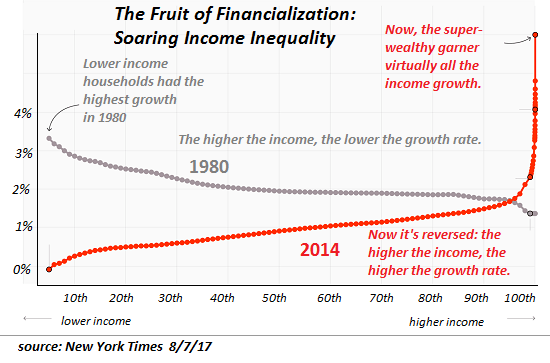
“From the end of the recession in 2009 through 2011 (the last year for which Census Bureau wealth data are available), the 8 million households in the U.S. with a net worth above $836,033 saw their aggregate wealth rise by an estimated $5.6 trillion, while the 111 million households with a net worth at or below that level saw their aggregate wealth decline by an estimated $600 billion.” Pew Research, “An Uneven Recovery, by Richard Fry and Paul Taylor.

Since the recession was officially declared to be over in June 2009, I have assured readers that there has been no recovery. Gerald Celente, John Williams (shadowstats.com), and no doubt others have also made it clear that the alleged recovery is an artifact of an understated inflation rate that produces an image of real economic growth.

Now comes the Pew Research Center with its conclusion that the recession ended only for the top 7 percent of households that have substantial holdings of stocks and bonds. The other 93% of the American population is still in recession. http://www.pewsocialtrends.org/2013/04/23/a-rise-in-wealth-for-the-wealthydeclines-for-the-lower-93/

Read full article.

Comments Off
Apr 28