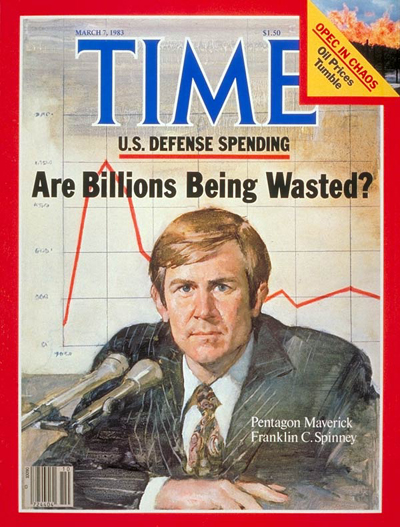
Chuck Spinney: Understanding the Arab Transformation — Political & Economic Harmonization, Not Democratization, Is Core First Step
Below is a very interesting summary of the political tensions among secularism and religion and modernism and tradition in Tunisia. I think the author, who I do not know but whose writings I have followed, is one of the most knowledgeable observers of the Arab Spring.
Chuck Spinney
Washington Report on Middle East Affairs
April 2013, Pages 41-42
By Esam Al-Amin
THE SPARK THAT ignited the Arab Spring over two years ago came from Sidi Bouzid in Tunisia. For 28 days people across the country revolted against the repression and corruption of the 23-year authoritarian regime of Zine El Abidine Ben Ali. Finally, on Jan. 14, 2011 Tunisians celebrated their victory and resilience over tyranny and oppression when Ben Ali fled the country. But if getting rid of the dictator was relatively short and easy, the dismantling of his regime and its corrosive effects on society has proven to be very challenging indeed.

Reference: 100 Critical Points About 9/11
100 Critical Points About 9/11
By “Tommy”
Introduction/Challenge to ‘Debunkers’:
It’s time for ‘debunkers’ to showcase their years of hard work. I’m looking for a concise and agreed-upon explanation for each of the following items so that we might forever put to rest these ‘nonsense conspiracy theories’ about 9/11.
Ideally, I’m hoping for a 1-4 sentence long, simplified explanation for each of these listed circumstances, explaining how they fit into the widely-accepted narrative. If any of these conditions were not present as alleged, or if you find them to be irrelevant, just explain a more accurate interpretation of the corresponding data.
Choose any number or set of numbers from the following list. For each point, write what you believe to be the official stance relative to the mainstream “Arab terrorist” narrative. Consistency and consensus is what we’re looking for. The goal of this article is to have each of these points adequately addressed in order to demonstrate, for any future “truthers”, that there is a reasonable explanation for these circumstances that was simply overlooked by the 9/11 Truth movement.
Eventually, I would like to be able to construct a full outline of the ‘debunker’ consensus on these most-relevant aspects of 9/11.
Some of the points, below, may seem familiar. Special thanks to Architects and Engineers for 9/11 Truth (VIDEO) and all of the honest institutions and individuals who have made this article possible.
Reference: The Seven Sins of American Foreign Policy
The Seven Sins of American Foreign Policy
Loch Johnson and Kiki Caruson
PSOnlone (January 2003)
1. Ignorance.
2. Lack of Empathy
3. Isolationalism
4. Unilateralism
5. Precipitate Military Action
6. Presidential Imperialism
7. Arrogance
Phi Beta Iota: The above are resorted and expanded in Loch Johnson (2006), Seven Sins of American Foreign Policy, Pearson.
Berto Jongman: Article on Local Peace Committees
Paul van Tongeren (2013): Potential cornerstone of infrastructures for peace? How local peace committees can make a difference, Peacebuilding, 1:1, 39-60
Potential cornerstone of infrastructures for peace? How local peace committees can make a difference
Paul van Tongeren
Co-founder, International Civil Society Network on Infrastructures for Peace, Amsterdam, The Netherlands
(Received 9 October 2012; final version received 28 November 2012)
In many conflict-affected countries local peace committees (LPCs) have an impact on local communities by keeping the violence down, solving community problems and empowering local actors to become peacebuilders. Of course, committees like these are confronted with many challenges; the biggest challenge is that they are very dependent on the broader, political or conflict environment. If that environment becomes very polarised or violent, they will be gravely affected. LPCs are committees or structures formed at the level of a town or village with the aim to encourage and facilitate joint, inclusive peacemaking and peacebuilding processes within their own context. The article describes 10 examples of LPCs in countries such as the Democratic Republic of Congo, Colombia and Afghanistan. It is remarkable to see that in those countries hundreds of LPCs exist, with in most cases limited impact. The article describes as well a broader framework of infrastructures for peace, as it is implemented in several countries, such as Ghana and Kenya. This is a promising approach. The article concludes with some conclusions and proposals to enhance LPCs and infrastructures for peace nationally and internationally.
Keywords: local peace committees; local peace communities; infrastructures for peace; local peace building
Reference (2010): Inteligencia: La <> de la Union Europea
PDF 22 pages: 2010 Intelligence as Sap of European Union Spanish
Abstract: This article reflects the importance of the consolidation of structures of Intelligence, able of canalizing the flows in the support and exchange of information that provide the preventive measures to the decision making that serves like fortification of the UE. The Intelligence considered like the sap, the food of the Union, must be had present like part fundamental in the vanguard of any policy to develop.
Reference (2004): La gestion de fuentes abiertas por los servicios de Inteligencia y los equipos de investigacion. El estado de la cuestion.
PDF 10 pages chapter: 2004 Fuentes Abiertas Jose Maria Felipo I Sarda
Abstract: This article reflects the importance of the consolidation of structures of Intelligence, able of canalizing the flows in the support and exchange of information that provide the preventive measures to the decision making that serves like fortification of the UE. The Intelligence considered like the sap, the food of the Union, must be had present like part fundamental in the vanguard of any policy to develop.
Reference (2008): Coopération européenne dans le renseignement, la piste de l’OSINT
PDF 1 page: 2008 Coopération européenne dans le renseignement, Axel Dyevre
Depuis quelques années, l’Open Source Intelligence (OSINT) a créé un fort engouement au sein des institutions européen – nes comme de beaucoup d’États membres. L’OSINT, c’est le renseignement sur sources ouvertes. C’est-à-dire la capacité pour un analyste de produire du renseignement, avec toute la valeur ajoutée induite à partir d’informations ne provenant pas de sources secrètes mais de sources non classifiées. L’imagerie satellite commerciale achetée pour le Centre satellitaire de Tojerron (EU SatCen) : OSINT ! Les divers systèmes de veille utilisés par la plupart des services pour faire de la recherche d’information sur Internet : OSINT ! Les multiples experts, d’origine académique ou non, s’exprimant sur leur sphère d’intérêt de manière publique ou pouvant être interviewés : OSINT encore ! Avec l’explosion des nouvelles
Reference (2008) OSINT: Its Implications for Business/Competitive Intelligence Analysis and Analysts
PDF 27 pages: 2008 Fleisher on OSINT English and Spanish
Abstract: The development of open sources as a viable source of inputs for intelligence efforts has been gaining in popularity. Both national intelligence agencies and business/commercial organizations have been ramping up their open source intelligence (OSINT) efforts, attempting to add even greater value to the overall intelligence endeavor through its utilization. This progress has occurred while both intelligence practitioners and their organizations wrestle with the challenges that arise from gathering and fusing the information flowing from this channel with flows coming from better established means.
This paper will focus principally on the challenges and opportunities that OSINT entails for the business/competitive intelligence (B/CI) analyst and consider its impact on the analysis process itself. Using research gathered from studies of scores of global enterprises, it will describe the current state of the art in analysis efforts of OSINT in business/commercial enterprises, examine the planning and execution challenges organizations are experiencing associated with effectively using and fusing OSINT, and provide guidelines associated with the successful use of OSINT within a number of leading private sector enterprises.
David Isenberg: James Howcroft on Making Intelligence Relevant in the 21st Century
Making Intelligence Relevant for the Missions of the 21st Century
Small Wars Journal | December 19, 2012
The international challenges which threaten the security of the United States and our partners in the 21st century are not primarily posed by conventional military forces. Despite the “pivot” toward a conventional peer competitor in Asia, the predominant source of conflict in the 21st century has been and will continue to be driven by events in fragile or failing states. Of the 27 active conflicts in the world today, only one is a traditional interstate war. Due to the forces of globalization, strife and conflict in these regions now can directly impact the security of citizens within our borders. Unaddressed conflict in these regions gives rise to organized crime networks which engage in trafficking of weapons, drugs, people and WMD components. Ethnic violence results in civil wars which often lead to humanitarian catastrophes and refugee migrations. Ungoverned space may result in terrorist sanctuaries and the spread of radical ideologies and beliefs. The most likely deployment mission will not be to engage against a traditional state’s military, but to engage in an unconventional conflict against non-state foes that use asymmetric tactics.
International security organizations and individual nations have various terms and definitions to address the range of possible operations to address security problems in fragile or failing states: Peace Operations, Peace Support Operations or Stability Operations are commonly used terms. The U.S Department of Defense (DOD) describes Stability Operations as: Military missions, tasks, and activities conducted outside the United States in coordination with other instruments of national power to maintain or reestablish a safe and secure environment, provide essential governmental services, emergency infrastructure reconstruction and humanitarian relief (Department of Defense Instruction 3000.05, “Stability Operations,” September 16, 2009, para. 3). Most often, regional security organizations, such as NATO or the African Union, empowered by the legitimacy of a UN Security Council mandate, form the headquarters or nucleus for ad hoc “coalitions of the willing” to carry out these missions. ISAF in Afghanistan, the African Union Mission in Somalia (AMISOM) and the NATO-led coalition operations in Libya are recent examples of this model. Due to the nature of the missions the military, while a major actor, is only one member of a wider interagency, comprehensive, “whole of government” team assembled to address security, governance, humanitarian and economic developmental needs.
There are numerous, complex challenges to producing and disseminating timely, accurate and fused intelligence to support these operations. Each step of the intelligence process must be adapted to meet the evolving needs of commanders, decision makers, soldiers and civilian partners on the ground. In this era of declining defense budgets, what lessons should intelligence professionals be incorporating into training and educational programs to make success more likely during the next deployment to a fragile or failed state? The following eight examples provide some insights to performing well in a complex environment. It is incumbent on leaders to communicate with and empower their intelligence officers to anticipate mission and information challenges. Incorporating aspects of these examples in training and education programs will help to ensure success on the next deployment.