2011 Peace from Above: Future of Intelligence & Air Power
The chapter more fully integrates the DNI spiral between modern mature intelligence (M4IS2) and modern mature Air Power.
Briefing 3.3 (29 Slides With Notes As Presented 3 MB ppt)
The chapter more fully integrates the DNI spiral between modern mature intelligence (M4IS2) and modern mature Air Power.
Briefing 3.3 (29 Slides With Notes As Presented 3 MB ppt)
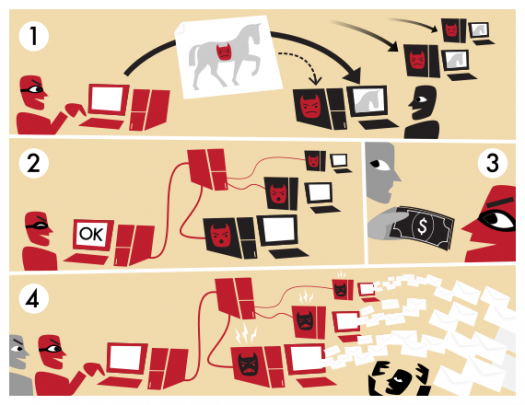
New Botnet, Now 4.5 Million Machines Strong, is ‘Practically Indestructible’
Today in cyber threats: more than four million Windows PCs have been commandeered by a botnet that cybersecurity experts are calling nearly “indestructible.” Known as TDL-4 (it’s the fourth iteration of the malicious program), this particular little nuisance hides in places security software rarely checks and speaks with other infected machines and their overseers in a novel encrypted code. Some are calling it the most sophisticated threat out there today. Watch your back, Stuxnet.
Phi Beta Iota: Apart from the known fact that the US Government ignored documented warning from Winn Schwartau, Jim Anderson, Bill Caelli, and Robert Steele in 1994, what we have here is the culimination of fifteen years in which governments continue to operate as Industrial Era hierarchies, choosing secrecy to protect incompetence rather than multinational sharing to achieve resilience–they are as a result inept beyond belief. The cloud–given the plethora of proprietary and therefore generally insecure hardware and software–is not going to be cleaned up on the present course, where spam is 75% of all email despite the best (isolated) efforts of all concerned. M4IS2, anyone?
Journal: Army Industrial-Era Network Security + Cyber-Security RECAP (Links to Past Posts)
Special report: Government in cyber fight but can’t keep up
Reuters, 16 June 2011
EXTRACT: Notwithstanding the military’s efforts, however, the overall gap appears to be widening, as adversaries and criminals move faster than government and corporations, and technologies such as mobile applications for smart phones proliferate more rapidly than policymakers can respond, officials and analysts said.
Phi Beta Iota: Duh. We told you so in 1994. Not only can the US Government not catch up, ever, but until there are the twin pillars of bottom up open source everything and a global M4IS2 grid, governments will continue to be part of the problem, not part of the solution.
IMF attack goal said to be network ‘insider presence’
‘It was a targeted attack,’ says expert who once worked for organization
Reuters, 11 June 2011
Phi Beta Iota: This is interesting on two levels. First, all instruments of Empire can expect to be attacked; without any central impetus, we anticipate a global cyber-intelligence and penetration network to develop, similar to what has matured for Free/Open Source Software, but with penetration, understanding, and neutralization of as the objective. A Cyber-Militia, if you will. Second, no government, no corporation, no international organization, can muster the global intelligence capability needed to be effective in today’s reality–the US Government least of all. An opportunity is emerging for a multinational decision-support centre and network co-sponsored by a mix of stakeholders who are willing to commit to absolute integrity. That is all it takes: integrity and a commitment to “The Virgin Truth.”
1994 Sounding the Alarm on Cyber-Security
Cyber-Virus Proliferation: USG as “Main Enemy”
2011 Cyber-Command or IO 21 + IO Roots
Journal: Army Industrial-Era Network Security + Cyber-Security RECAP (Links to Past Posts)
Search: Steele USMC C4I 1990′s
Analysis: In “borderless” cyberspace, nation states struggle
By Peter Apps, Political Risk Correspondent
Reuters LONDON | Thu Jun 9, 2011
EXTRACT:
“The nature of cyberspace is borderless and anonymous,” R. Chandrasekhara, secretary of India’s telecommunications department, told a cyber security conference in London last week organised by a U.S.-based think tank, the EastWest Institute. “Governments, countries and law — all are linked to territory. There is a fundamental contradiction.”
Tip of the Hat to Chris Pallaris at LinkedIn.
Phi Beta Iota: The national secret intelligence communities mean well, but they are cognitively and culturally incapacitated in relation to both the global threats and the global infomation sharing and sense-making possibilities. It may just be that the solution has to come from a private sector service of common concern that can provide the integrity now lacking in governments and most corporation. Scary thought. M4IS2 is inevitable….delay is costing trillions.
Doc Searls on user-driven democracy
by jonl
Speaking at the 2011 Personal Democracy Forum, Doc talks about how power relationships work in markets vs how they should and could work. Markets are conversations, and they should be symmetrical conversations. Note his bit about how the language of marketing parallels the language of slavery….and the part where all their cookies end up giving them 50% completely wrong information.
Doc is the co-author of the Clue-Train Manifesto.
Direct Link to Personal Democracy Video
See Also:
Pogo reigns supreme…..
Pentagon Will Consider Cyberattacks Acts of War
By DAVID E. SANGER and ELISABETH BUMILLER
New York Times, May 31, 2011
WASHINGTON — The Pentagon, trying to create a formal strategy to deter cyberattacks on the United States, plans to issue a new strategy soon declaring that a computer attack from a foreign nation can be considered an act of war that may result in a military response.
Phi Beta Iota: These people literally have no clue and are simply striving for budget share before Pentagon right-sizing gets underway. We absolutely guarantee that what the Pentagon and the US Intelligence Community do to their own employees every day (including forbidding thumb drives now) qualifies as a crime against humanity as well as an act of war. The USG is its own worst enemy in every possible sense.
2011 Cyber-Command or IO 21 + IO Roots
Bob Gates, Chief Maintenance Clerk, Talks Crap — and the Wall Street Journal Goes Along…
Defense and the Deficit–Busting the Defense Bubble, Ending Defense Entitlement
Reference: The Pentagon Labyrinth
Review (Guest): The Pentagon Labyrinth
Review: Grand Theft Pentagon–Tales of Corruption and Profiteering in the War on Terror
Is it just me, or does it appear that we’re okay with selling our cyber-soul to China (and Russia), as long as we can also blow tens of billions on US firms pretending to do cyber-security?
Report: Despite status as U.S. security threat, China’s Huawei partnering with Symantec
East-Asia-Intel.com, April 27, 2011
The Chinese telecom giant Huawei Technologies, which has been linked to the Chinese military, is working with the U.S. software security giant Symantec, which is engaged in securing hundreds of thousands of U.S. computer systems against outside intrusions, according to a report last week in the Diplomat newsletter.
The report said “China and Russia are leveraging U.S. multinational corporations’ economic requirements to accomplish strategic goals that could quite plausibly include covert technology transfer of intellectual property, access to source code for use in malware creation and backdoor access to critical infrastructure.”
Huawei was blocked from buying the U.S. telecom 3Leaf last year by the Committee on Foreign Investment in the United States (CFIUS) and also was blocked in 2008 from buying 3Com over security concerns. The U.S. National Security Agency also stepped in to dissuade AT&T from buying Huawei telephone equipment.
Despite those actions, Huawei formed a joint venture with Symantec in 2007 called Huawei Symantec Technologies Co. Ltd. (HS), the report said. Huawei is the majority partner with 51 percent ownership, with the entity being headquartered in Chengdu, China.
The report said a 2008 report identified HS as developing “China’s first laboratory of attack and defense for networks and applications.”
The result is that Symantec is assisting China’s cyber development of computer warfare capability.
The report was produced by cyber security expert Jeffrey Carr, author of Inside Cyber Warfare: Mapping the Cyber Underworld (O’Reilly, 2009).
Phi Beta Iota: The US Government compounds its lack of a strategic analytic model and the requisite integrity to actually pay attention to whatever findings might emerge, with an abysmal inattention to the most basic aspects of counter-intelligence, not just within government, but across the private sector, which does not actually take counter-intelligence seriously either. Creating a Smart and Safe Nation is not difficult–it requires only a uniform commitment to intelligence and integrity across all boundaries.
On the evening on March 24, 2011, EFF staff activists will discuss the state of government surveillance and privacy in the United States at “Government Surveillance in a Digital World,” an event hosted by San Francisco Intersection for the Arts, with a live video stream by BAMM.tv.
One of the many topics to be discussed is the PATRIOT Act. For nearly ten years, EFF has fought to reform or repeal the overbroad authority granted to law enforcement through the PATRIOT Act, and this year, we have a chance to introduce significant reforms. Thanks to bipartisan opposition and the efforts of grassroots activists, Congress rejected a rubber-stamp reauthorization of the PATRIOT Act and instead vowed to spend three months debating reforms to this law. This gives us an incredible opportunity to speak out against the PATRIOT Act and tell Congress that we don’t want any laws that trample on our civil liberties.
Join the EFF activism team in person or online for a a wide-ranging discussion on privacy in the digital world, online free expression, and how we can work together to stop Congress from reauthorizing a PATRIOT Act that enables excessive government surveillance.
REFERENCE
Lessons from Anonymous on cyberwar
A cyberwar is brewing, and Anonymous reprisal attacks on HBGary Federal shows how deep the war goes.
Haroon Meer 10 Mar 2011 16:11 GMT
Al Jazeera
. . . . . . .
Even while Barr was proclaiming victory and threatening to “take the gloves off”, Anonymous were burrowing deeper into his network.
By the end of the attack, Barr’s iPad was reputedly erased, his LinkedIn and Twitter accounts were hijacked, the HBGary Federal website was defaced, proprietary HBGary source code was stolen and with over 71,000 private emails now published to the internet, HBGary was laid bare.
In this, was our first lesson: The asymmetry of cyber warfare.
. . . . . . .