Videos on Election Fraud/Theft
+ Stealing America: Vote by Vote
+ American Blackout: documentary of Greg Palast’s investigation into voter fraud
+ UNCOUNTED: The New Math of American Elections
+ Hacking Democracy: The HBO Special
+ Election theft video archive from Votescam.org
Note: Diebold – “Diebold Election Systems” acquired by “Premiere Election Solutions” then acquired by “ES&S” which was acquired by “Dominion” in 2010 (wikipedia).
Also see:
+ BlackBoxVoting.org
+ Votersunite.org
+ VerifiedVoting.org
+ Election Defense Alliance
+ Citizens for Legitimate Gov
Event: Oct 15-Jan 9, UN, Design with the Other 90% Cities
Design with the Other 90%: CITIES features sixty projects, proposals, and solutions that address the complex issues arising from the unprecedented rise of informal settlements in emerging and developing economies. Divided into six themes—Exchange, Reveal, Adapt, Include, Prosper and Access—to help orient the visitor, the exhibition shines the spotlight on communities, designers, architects, and private, civic, and public organizations that are working together to formulate innovative approaches to urban planning, affordable housing, entrepreneurship, nonformal education, public health, and more.
Comment: Design for the other 90% is a great ‘movement’ but the sponsorship of this event (Citi & Rockefeller Foundation) + UN makes for an unsettling partnership when considering the divide between “the 1%” & “the 99%” and the questions behind the intentions of having their names affiliated with “helping the poor.” I would hope that those within those organizations who can genuinely make a difference are not trumped by those looking to exploit those in poverty.
Worth a Look: Between the Bars: Human stories from prison
Between the Bars is a weblog platform for prisoners, through which the 1% of Americans who are in prison can tell their stories. Leave a comment – we’ll pass it on.
In part with the help of MIT Civic Media.
IBM: proceed with caution (WWII to the present)
3 examples:
IBM is working with DARPA
IBM Testing Biometric Technology for Retail Advertising
How IBM Tech Helped Jump Start the Holocaust
Comment: I would be cautious+keen of the “smart planet” vision of those running IBM, they have made the brand popular for spreading to all cities. Keep an eye on them (biometric pun, sorry) and be friendly.
Patrick Meier: Ushahidi Emergent as Democracy in Being
Theorizing Ushahidi: An Academic Treatise
[This is an excerpt taken from Chapter 1 of my dissertation]
Activists are not only turning to social media to document unfolding events, they are increasingly mapping these events for the world to bear witness. We’ve seen this happen in Tunisia, Egypt, Libya, Syria, Yemen and beyond. My colleague Alexey Sidorenko describes this new phenomenon as a “mapping reflex.” When student activists from Khartoum got in touch earlier this year, they specifically asked for a map, one that would display their pro-democracy protests and the government crackdown. Why? They wanted the world to see that the Arab Spring extended to the Sudan.
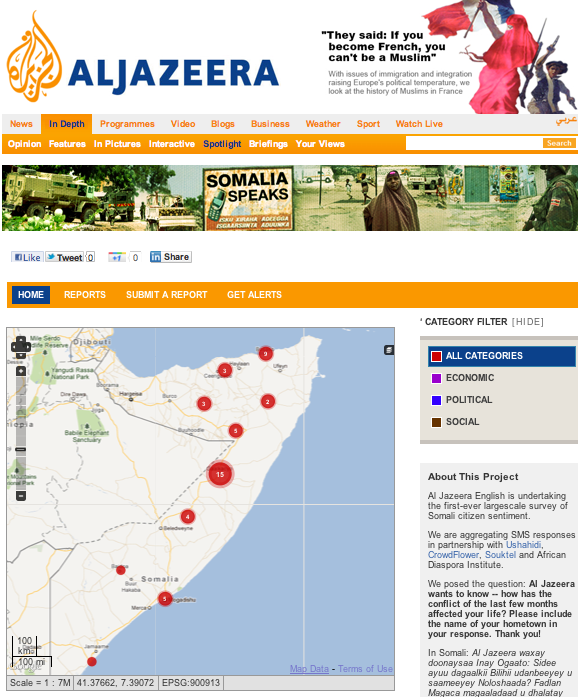
The Ushahidi platform is increasingly used to map information generated by crowds in near-real time like the picture depicted above. Why is this important? Because live public maps can help synchronize shared awareness, an important catalyzing factor of social movements, according to Jürgen Habermas. Recall Habermas’s treaties that “those who take on the tools of open expression become a public, and the presence of a synchronized public increasingly constrains un-democratic rulers while expanding the right of that public.”
Event: NYC Oct 10-16, MobilityShifts – An International Future of Learning Summit
Digital Fluencies for a Mobile World
What are new pedagogic approaches for learning with mobile platforms? What are the limitations of the “digital literacies” paradigm and its first world/third world assumptions?
How do we promulgate digital fluency as an understanding of the particular features of global information flows in which data, attention, capital, and reputation might move both to and from individual actors and communities?
How can mobile media platforms be used for more than the one-way delivery of content? What are new pedagogical approaches for real-time mobile learning that make full use of the potential of mobile phones, iPods, laptops, PDAs, smart phones, Tablet PCs, and netbooks in formal and informal contexts? How can global participants use mobile media to create rich social contexts around important learning tasks? How can such platforms be leveraged to teach digital rights and the value of collaboration across cultures?
How can we dispel the myth of the digital native?
How can mobile networks reshape our experiences of space and place through interactive architecture, locative art, geo-caching games, and real-time object recognition? What opportunities for networked teaching and learning might we find in such media-rich, responsive environments?
Robert Steele: Ignored 1994, Ignored 2011–Deja Vu
One of our contributors passed this to me and asked me to comment in relation to the alarm that Winn Schwartau, Bill Caeli, Jim Anderson, and I sounded in 1994, in writing, to Marty Harris, then head of the National Information Infrastructure (NII).
First, the item.
From the man who discovered Stuxnet, dire warnings one year later
Mark Clayton
Christian Science Monitor, 22 September 2011
Stuxnet, the cyberweapon that attacked and damaged an Iranian nuclear facility, has opened a Pandora’s box of cyberwar, says the man who uncovered it. A Q&A about the potential threats.
EXTRACT:
CSM: How would you characterize the year since Stuxnet – the response by nations, industry and government?
LANGNER: Last year, after Stuxnet was identified as a weapon, we recommended to every asset owner in America – owners of power plants, chemical plants, refineries and others – to make it a top priority to protect their systems…. That wakeup call lasted only about a week. Thereafter, everybody fell back into coma. The most bizarre thing is that even the Department of Homeland Security (DHS) and Siemens [maker of the industrial control system targeted by Stuxnet] talked about Stuxnet being a wakeup call, but never got into the specifics of what needed to be done.
Interview: Author of ‘Epic Win for Anonymous’
One on One: Cole Stryker, Author of ‘Epic Win for Anonymous’
By JENNA WORTHAM
Cole Stryker, a freelance writer and media consultant living in New York, spent years digging into Internet culture and communities, both as a participant and as a blogger covering viral phenomena. He’s the author of a new book called “Epic Win for Anonymous: How 4chan’s Army Conquered the Web.” He discussed with me what it’s like exploring the seedy underbelly of the Internet, the rise of Anonymous, and why it and 4chan, widely considered one of the darkest and most subversive corners of the Internet, may be one of the most important and influential creations to emerge from the modern Web.
Seth Godin: Back to (the wrong) school — inspires a plan to retrain 44% of the US workforce in one year
Back to (the wrong) school
A hundred and fifty years ago, adults were incensed about child labor. Low-wage kids were taking jobs away from hard-working adults.
Sure, there was some moral outrage at seven-year olds losing fingers and being abused at work, but the economic rationale was paramount. Factory owners insisted that losing child workers would be catastrophic to their industries and fought hard to keep the kids at work–they said they couldn’t afford to hire adults. It wasn’t until 1918 that nationwide compulsory education was in place.
Part of the rationale to sell this major transformation to industrialists was that educated kids would actually become more compliant and productive workers. Our current system of teaching kids to sit in straight rows and obey instructions isn’t a coincidence–it was an investment in our economic future. The plan: trade short-term child labor wages for longer-term productivity by giving kids a head start in doing what they’re told.
Large-scale education was never about teaching kids or creating scholars. It was invented to churn out adults who worked well within the system.
Of course, it worked. Several generations of productive, fully employed workers followed. But now?