Berto Jongman
Today’s recommendaitons:
Who’s who in the Somali insurgency: A Reference Guide
Interview with Maajid Nawaz:Becoming a Muslim Radical
New Quilliam report: British prisons are incubating Islamist extremism
Selected Translation of the LIFG Recantation Document

Amazon Page
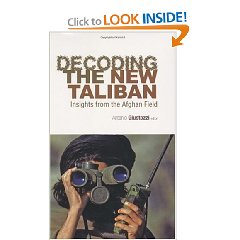
Decoding the New Taliban: Insights from the Afghan Field. Antonio Giustozzi gathers a renowned cast of journalists, experts, and academics to answer the most pressing questions regarding the Taliban today. Each contributor possesses extensive knowledge of the insurgency’s latest developments, decoding its structure and organization as it operates within specific regions and provinces. They analyze the new Taliban as it expands, from the mature south, where they hold sway, to the southeast, where they struggle to penetrate, from the west and northeast, now in the initial stages of infiltration, to the provinces surrounding Kabul, which have been unexpectedly and quickly occupied.

Amazon Page
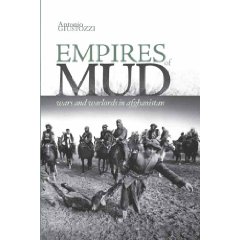
Empires of Mud: The Neo-Taliban Insurgency in Afghanistan 2002-2007. Warlords are charismatic leaders who exploit weak authorities to gain control of subnational areas. Nevertheless, warlords do in fact participate in state formation, and this book considers the dynamics of warlordism within the context of such debates. Antonio Giustozzi begins with aspects of the Afghan environment that are conducive to the fragmentation of central authority and the emergence of warlords. He then accounts for the phenomenon from the 1980s to today, considering Afghanistan’s two foremost warlords, Ismail Khan and Abdul Rashid Dostum, along with their political, economic, and military systems of rule.
Nov 17

Global Outlook on False Flag Operations
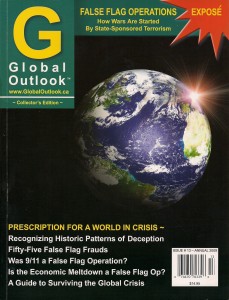
Here to the side is the cover of an extraordinary and appropriately titled Collector’s Edition of Global Outlook, Issue 13 Annual 2009. We consider it the New Age counterpart to the first Whole Earth Catlog, a non-violent alternative to the Aranrchist Cookbook.
As with most publications where passion is paramount, we retain a reserve of caution on perhaps 20% of the content, but the other 80% is not only truthful content, it is truthful content not available from any government or media source that has been artfully and intelligently integrated from a vast array of non-fiction sources.
Sub-titled Prescription for a World in Crisis, this volume has seven parts and a resource guide, the parts focusing on the invisible government; historic patterns of deception, why 9/11 was a false flag operation; why so many cannot see through the official lies; Swine Flue Vacinations and Internet Censorship (or Shut-Down as potential operations; other strategies of the invisible government; and a guide to surviving the global crisis.
Read the rest of this entry »
Sep 20

Full Story Online
Secrecy: The Nation’s Favored Fraud
Pierre Tristam
Published on Tuesday, November 26, 2002 by the Daytona Beach News-Journal (Florida)
If there is any doubt at all that the terrorists have won – that they have managed with a single day’s freakish hits to revamp the most open society on earth into an emerging police state where suspicion and secrecy are the twin watch-towers of government and cowering and conforming the prevailing instincts of an allegedly free press or an even more alleged political opposition – then last week’s creation of the Department of Homeland Security should put all such doubts to rest.
. . . . . . .
Secrecy is national security’s favored fraud. With rare exceptions, it harms the public interest more than it protects it. Keeping America’s atom bomb secret may have been a good idea, but even that failed. Keeping the Pentagon Papers secret, the government’s own most damning evidence that the Vietnam War was a known failure even in the early 1960s, needlessly prolonged a needless war at the cost of thousands of American lives (and perhaps a million Vietnamese). Designed around the same principle of prescribing what Americans should and should not know, the new department will incubate just such secrets, covering up what should be known at the risk of prolonging what shouldn’t be happening. Substitute Main Street for rice paddies and what’s ahead is less reassuring because of the department’s existence.
Phi Beta Iota: We testified to the Moynihan Commission, and all of our life’s work in the world of secrecy confirms the views of Rodney McDaniel, thenExecutive Secretary of the National Security Council: 90% (we say 80%) of secrecy is bureaucratic turf control (and avoidance of accountability), only 10% (we say 20%) is legitimate portection of sensitive information.
Sep 7
As we contemplated the reality that the U.S. Government does not have an information strategy, we realized it may not even know what one is. Below is a snippet from an EZine article that captures the broad picture.

Full Story Online
Design an Information Strategy
By Robert G. Ogilvie
Despite investments of millions of dollars in Information Technology, we seldom come across an organization that has actually designed an information strategy that focuses on collecting and processing information for strategic decision making.
. . . . . . .
Read the rest of this entry »
Aug 31