Reference: FBIS in Its Own Words….

Categories: Memoranda

cia-04-0106.pdf CIA FBIS Transformed into Open Source Spying January 3, 2010 (470KB)

Douglas Naquin interviewed 6 January 2004

See Also:

Journal: In Defense of RSS–Does USIC OSC “Get” RSS?

Comments Off
Jan 3

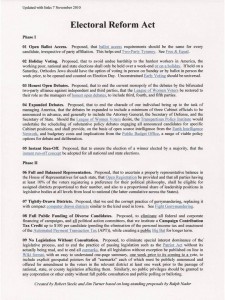
Reference: Electoral Reform–1 Page 9 Points 2.2

Electoral Reform 2.2

UPDATED 8 Nov 2011 to bury.  This is the original that everyone ignored, now that Electoral Reform Act of 2012 has gone viral courtesy of Reddit and YouTube, the updated versions of the proposed Statement of Demand and the Electoral Reform Act of 2012 can be found at http://tinyurl.com/OWS-ER-HO.

UPDATED 29 May 2011 to add top-level link:

Seven Promises to America–Who Will Do This?

Electoral Reform is the “fast track” toward restoring the Constitution and the Republic (We the People must be sovereign or it is not a Republic).  As long as the Executive and Congress are led by unethical politicians working for unethical corporations, public intelligence can and should be used to expose each individual, each transaction, each transgression.  That is the “slow road.”  However, if the Independents, Greens, Reforms, and the honest Libertarians (not faux Libertarians like the Koch Brothers) can get together on this ONE THING, the “fast track” is possible in time for 2012.

Full text of one pager below the line.

Read the rest of this entry »

Comments Off
Dec 13

Reference: Panetta Puts Lipstick on the Pig (Again)

Categories: Government,Memoranda
Tags:

No Change Needed....

Message from the Director: Lessons from Khowst

Last December, our Agency family lost seven courageous and talented colleagues in a terrorist attack at Forward Operating Base Chapman in Khowst, Afghanistan. These dedicated men and women were assigned to CIA’s top priority—disrupting and dismantling al-Qa’ida and its militant allies. That work carries, by its very nature, significant risk. CIA is conducting the most aggressive counterterrorism operations in our history, a mission we are pursuing with a level of determination worthy of our fallen heroes. We will sustain that momentum and, whenever possible, intensify our pursuit. We will continue to fight for a safer America.

Earlier this year, I directed that a task force of seasoned Agency professionals conduct a review of the Khowst attack. The purpose was to examine what happened, what lessons were learned, and what steps should be taken to prevent such incidents in the future. In addition, I asked Ambassador Thomas Pickering and Charlie Allen, a highly accomplished former Agency officer, to conduct an independent study of the Khowst attack and to review the work of the task force. They concurred with its findings. One of CIA’s greatest strengths is our ability to learn from experience, refine our methods, and adapt to the shifting tactics of America’s enemies.

The review is now complete, and I would like to thank those who participated. They did our Agency a great service. It was, to be sure, a difficult task—especially since key insights perished with those we lost. Perfect visibility into all that contributed to the attack is therefore impossible. But based on an exhaustive examination of the available information, we have a firm understanding of what our Agency could have done better. In keeping with past practice, we will provide the Khowst report to the Office of Inspector General.

In highly sensitive, complex counterterrorism operations, our officers must often deal with dangerous people in situations involving a high degree of ambiguity and risk. The task force noted that the Khowst assailant fit the description of someone who could offer us access to some of our most vicious enemies. He had already provided information that was independently verified. The decision to meet him at the Khowst base—with the objective of gaining additional intelligence on high priority terrorist targets—was the product of consultations between Headquarters and the field. He had confirmed access within extremist circles, making a covert relationship with him—if he was acting in good faith—potentially very productive. But he had not rejected his terrorist roots. He was, in fact, a brutal murderer.

Mitigating the risk inherent in intelligence operations, especially the most sensitive ones, is essential to success. In this case, the task force determined that the Khowst assailant was not fully vetted and that sufficient security precautions were not taken. These missteps occurred because of shortcomings across several Agency components in areas including communications, documentation, and management oversight. Coupled with a powerful drive to disrupt al-Qa’ida, these factors contributed to the tragedy at Khowst. Each played an important role; none was more important than the others. Based on the findings of the task force and the independent review, responsibility cannot be assigned to any particular individual or group. Rather, it was the intense determination to accomplish the mission that influenced the judgments that were made.

There are no guarantees in the dangerous work of counterterrorism, but the task force identified six key areas that deserve greater focus as we carry out that vital mission. We will:

  • Enforce greater discipline in communications, ensuring that key guidance, operational facts, and judgments are conveyed and clearly flagged in formal channels.
  • Strengthen our attention to counterintelligence concerns while maintaining a wartime footing.
  • Apply the skills and experience of senior officers more effectively in sensitive cases.
  • Require greater standardization of security procedures.
  • More carefully manage information sharing with other intelligence services.
  • Maintain our high operational tempo against terrorist targets, even as we make adjustments to how we conduct our essential mission.

I have approved 23 specific actions recommended by the task force, some of which I ordered implemented months ago. They provide for organizational and resource changes, communications improvements, tightened security procedures, more focused training, and reinforced counterintelligence practices. These include:

  • Establishing a War Zone Board made up of senior officers from several components and chaired by the Director of the National Clandestine Service. It will conduct a baseline review of our staffing, training, security, and resources in the most dangerous areas where we operate.
  • Assembling a select surge cadre of veteran officers who will lend their expertise to our most critical counterterrorism operations.
  • Creating an NCS Deputy within the Counterterrorism Center, who will report to the Director of the Counterterrorism Center and ensure a more integrated effort across Agency offices.
  • Conducting a thorough review of our security measures and applying even more rigorous standards at all our facilities.
  • Expanding our training effort for both managers and officers on hostile environments and counterintelligence challenges.
  • Creating an integrated counterintelligence vetting cell within our Counterterrorism Center that focuses on high-risk/high-gain assets, evaluates potential threats, assesses “lessons learned,” and applies the latest technology and best practices to counterterrorism operations.
  • Designating a senior officer to ensure that all the recommendations are indeed implemented.

We’ve now taken a hard look at what happened and what needed to be done after the tragedy at Khowst. While we cannot eliminate all of the risks involved in fighting a war, we can and will do a better job of protecting our officers. Drawing on the work of the task force and its insights, it’s time to move forward. Nothing in the report can relieve the pain of losing our seven fallen colleagues. By putting their lives on the line to pursue our nation’s terrorist enemies, they taught us what bravery is all about. It is that legacy that we will always remember in our hearts.

Leon E. Panetta

Posted: Oct 19, 2010 06:30 PM
Last Updated: Oct 19, 2010 06:30 PM
Last Reviewed: Oct 19, 2010 06:30 PM

Phi Beta Iota: Can’t fix stupid.

See also:

Journal: CIA Officer Blew Off Warning in Jordon Weeks in Advance of Jordanian Suicide Bombing in Afghanistan that Killed Seven

Journal: The Truth on Khost Kathy

Journal: CIA Leads the “Walking Dead” in USA (With RECAP Links)

Reference: Fixing Intel–A Blueprint for Making Intelligence Relevant in Afghanistan

Reference: Retired CIA officer–Fix the Agency

Review: Beyond Repair: The Decline and Fall of the CIA

Review: The Human Factor–Inside the CIA’s Dysfunctional Intelligence Culture

Worth a Look: Book Reviews on Intelligence (Lack Of)

Comments Off
Oct 21

Reference: Multinational Multicultural Postings

Categories: Memoranda

We had to stop with just one year.  This web site is inherently multinational and multicultural, just in its infancy.

Multinational Postings One Year (Of Five Years)

Comments Off
Sep 5

Reference: Dr. Dr. Dave Warner & Synergy Strike Force in Afghanistan–”Save the Willing First”

Tags:

Strike Force Handbook

Dr. Dr. Dave Warner (PhD, MD)

Ref A:  Cyber-Pass Meets Khyber Pass

Ref B:   Warner to Clapper on PRT Comms

Ref C:  UnityNet White Paper Final

Strike Force Home Page

See Also:

Earth Intelligence Network “One Call At a Time”

Lee Felsenstein Concept for Cellular Aid

AidData

INTELLIGENCE for EARTH

Comments Off
Jul 10

Reference: BGen McMaster at ODNI on Afghanistan

Tags:

Memo corrected to remove (Ret).  BGen McMaster was promoted to his present rank on 29 June 2009 after being twice passed over (2006, 2007), presumably for having the integrity to be outspoken.  He is the author of the widely-admired book Dereliction of Duty: Johnson, McNamara, the Joint Chiefs of Staff, and the Lies That Led to Vietnam.

Nine key factors are examined by BGen McMaster in his talk to the Office of the Director of National Intelligence (ODNI).  Answers question on why we were so unprepared.  Final paragraph of trip report:

Can’t get much from a database and IT networks, but contractors keep pushing and we keep buying.   But what really need is experts from anywhere, context, and also need to ask the soldiers!  Make Phebe Marr a general!  Also pay attention to: Charles Tripp, R. Kadeiri, Sarah Chayes, Barnett R. Rubin and Ahmed Rashid, Michael Howard, Frontline piece on Children of the Taliban, Fariad Ali Han on borders.  Educate analysts (and self-educate) on the place, don’t waste time training them on the process.

Jan 20

Reference: CJCS & Frog 6 Strategic Guidance Side-by-Side (Each is Six Pages)

Categories: DoD,Memoranda

CJCS Strategic Guidance

Alternative Strategic Guidance 1.3

Comments Off
Dec 27

Reference: Trip Report on Arlington Workshop About Imminent Catastrophic Failures and Emergent Resilience Possibilities

Categories: Memoranda
Three-Page Trip Report

Three-Page Trip Report

Comments Off
Dec 14

Event Report: 20 Nov 09 NYC Counterinsurgency–America’s Strategic Burden Featuring Nagl, Kilcullen, Sheehan, Bergen, Coll Among Others

Categories: Memoranda

COIN20 Trip Report

COIN20 Trip Report

21 November 2009

Memorandum of Transmittal by Robert David STEELE Vivas

Subject:  Counterinsurgency Conference Overview

Mr. Jason Liszkiewicz, Executive Director of the Earth Intelligence Network (EIN) and resident in NYC, attended the 20 November 2009 conference on counterinsurgency (speakers identified on page two), and provided me with the notes on pages 3-9.  Below is my own exploitation of these notes.

IGNORANT US POLICYMAKERS.  We have policymakers with crippling illusions about how the world is—worst ever—people in policy positions do not understand the problems they are making policy on—Congress is unsophisticated about Afghanistan; Washington-area decision-makers vastly misunderstand the enemy—Taliban is a super-bug  adapting super-fast.  This is NOT about Al Qaeda having a home base.  Congress lacks next of kin engaged.

CORRUPT AFGHAN OFFICIALS. Afghan government officials own 32% of the Palm Islands in Dubai—election was “industrial-strength fraud”—tsunami of cash (US, Saudi, others) drives corruption.  NOTE:  No Afghans on any of the panels.

US LACKS AREA KNOWLEDGE & STRATEGY. We really do not “get” the Afghanistan-Pakistan-India  context, detail, etcetera.  US “strategy” of “ten cities” is a mirror of the Soviet strategy before defeat.  Doctrine is not a substitute for Strategy.  Water (Indus River) is central to Pakistan-India relationship (Kashmir is about water).  Question NOT being asked: how do we do this without a US ground presence?  “Cheap coat of paint” approach to challenges.  “Tactics without strategy is noise before defeat.”  Saudi money, Pakistan-Taliban axis will outlast US money and US ground presence.

COUNTERINSURGENCY MANUAL LACKING. Counterinsurgency manual is not realistic and warps policy debate—the reality of poppy crops is not in the manual, not in the “strategy/doctrine”

UN, AID, NGO OOB NOT WORKNG. UN not working, its role not thought out, shortfalls in specialized everything.  Local corruption and family-political angling for contracts lead to some IED’s intended to block or redirect contract funds.  AID  giving contracts to Americans, not Afghans.  US has no ability to create ministries from scratch.  Civilian capabilities non-existent or not understood by military when they do show up.  No inter-agency planning in part because the civilians have no idea why they are there or what they should do.

LOST IN TRANSLATION. Continue to lack Pashto translators.   More Pashto speakers within NYPD than in all US forces across Afghanistan

EXIT OPPORTUNITIES. Afghan Army most respected institution in country, best fighters but worst policemen.  US ground presence makes things worse.  Solutions have to be Afghan.  Afghan population wants sovereignty and independence.  US troops simply surviving, not campaigning.

On page 10 I provide the “Lessons Learned” from my 1992 study of USMC operations.

Nov 24

Officers’ Call–Conversation About Iraq I

Iraq Truth in Eight Pages

Iraq Truth in Eight Pages

One of the great things about being the touchstone for public intelligence is the contacts that are made by students, officers and enlisted personnel serving in the field, and so many others.

While we were in Denmark, an officer now serving in Iraq sent us some questions that we answered to the best of our ability.  The questions alone are listed here.  For the answers, click on the cover.

1. We never should have invaded Iraq. I have a less developed opinion on Afghanistan, but if I had to say one way or another, that was probably a mistake as well.

Do these mistakes fall solely on the Bush administration?

Was the administrating that incompetent or did they have an immoral and selfish reason such as fleecing the U.S.?

Was it shortsighted political gain objectives with an underestimation of the downside?

We will have at least double the amount of dead service members before these conflicts are over as were killed during the 9/11 attacks.  I read somewhere that we have 75,000 amputees due to the two conflicts not to mention the amount of PTSD.  Who has the blood on their hands? Certainly nobody is willing to admit mistakes.

I don’t understand how Cheney can even think about spouting off after how the conflicts have gone. Where is the cost vs gain analysis?

2. Once we did invade, we didn’t have a solid plan and we didn’t bring nearly enough troops if we planned on staying. Was this mainly Rumsfeld’s fault?

Read the rest of this entry »

Comments Off
Oct 30