Categories:
02 Diplomacy,
03 Economy,
09 Justice,
10 Security,
11 Society,
Advanced Cyber/IO,
Augmented Reality,
Civil Society,
Collective Intelligence,
Counter-Oppression/Counter-Dictatorship Practices,
Cultural Intelligence,
Ethics,
InfoOps (IO),
Methods & Process,
Officers Call,
Politics of Science & Science of Politics,
Power Behind-the-Scenes/Special Interests,
Secrecy & Politics of Secrecy,
Strategy,
Technologies,
TED Videos

John Perry Barlow
TEDxMarin – John Perry Barlow – The Right to Know
16:56
Phi Beta Iota: This is classic Barlow, totally new fresh look, a moving and deeply engaging personal monologue on where we are, where we are going.
“Thought is not a noun to be owned, it is a verb, an action.”
“Copyright is the wrong model for monetizing thinking.”
See Also:
Electronic Frontier Foundation
1992 Barlow (US) Information Wants to Be Free
Review: The Virtual Community–Homesteading on the Electronic Frontier
Jun 1

Maude Barlow
Our Commons Future is Already Here
A stirring call to unite the environmental and global justice movement from Maude Barlow
By Maude Barlow
Maude Barlow gave this stirring plenary speech, full of hope even in the face of ecological disasters, to the Environmental Grantmakers Association annual retreat in Pacific Grove, California. Barlow, a former UN Senior Water Advisor, is National Chairperson of the Council of Canadians and founder of the Blue Planet Project.
- – - – - -
Half the tropical forests in the world – the lungs of our ecosystems – are gone; by 2030, at the current rate of harvest, only 10% will be left standing. Ninety percent of the big fish in the sea are gone, victim to wanton predatory fishing practices. Says a prominent scientist studying their demise “there is no blue frontier left.” Half the world’s wetlands – the kidneys of our ecosystems – were destroyed in the 20th century. Species extinction is taking place at a rate one thousand times greater than before humans existed. According to a Smithsonian scientist, we are headed toward a “biodiversity deficit” in which species and ecosystems will be destroyed at a rate faster than Nature can create new ones.
We are polluting our lakes, rivers and streams to death. Every day, 2 million tons of sewage and industrial and agricultural waste are discharged into the world’s water, the equivalent of the weight of the entire human population of 6.8 billion people. The amount of wastewater produced annually is about six times more water than exists in all the rivers of the world. A comprehensive new global study recently reported that 80% of the world’s rivers are now in peril, affecting 5 billion people on the planet. We are also mining our groundwater far faster than nature can replenish it, sucking it up to grow water-guzzling chemical-fed crops in deserts or to water thirsty cities that dump an astounding 200 trillion gallons of land-based water as waste in the oceans every year. The global mining industry sucks up another 200 trillion gallons, which it leaves behind as poison. Fully one third of global water withdrawals are now used to produce biofuels, enough water to feed the world. A recent global survey of groundwater found that the rate of depletion more than doubled in the last half century. If water was drained as rapidly from the Great Lakes, they would be bone dry in 80 years.
The global water crisis is the greatest ecological and human threat humanity has ever faced.
Read full presentation….
See Also:
Worth a Look: Book Reviews on Water
Nov 2
Categories:
6 Star Special,
Capitalism (Good & Bad),
Civil Society,
Complexity & Catastrophe,
Economics,
Environment (Problems),
Intelligence (Public),
Nature, Diet, Memetics, Design,
Politics,
Power (Pathologies & Utilization),
Survival & Sustainment,
True Cost & Toxicity,
United Nations & NGOs,
Values, Ethics, Sustainable Evolution,
Voices Lost (Indigenous, Gender, Poor, Marginalized),
Water, Energy, Oil, Scarcity

Amazon Page
6 Star Plus Foundation Work,
August 28, 2010
Maude Barlow and Tony Clarke
I read the authors’ more recent Blue Covenant: The Global Water Crisis and the Coming Battle for the Right to Water yesterday and watched the also more recent Blue Gold: World Water Wars last night, all in the context of raeding 12 books on water I bought for a UNESCO project I had to drop from when I joined the UN in Guatemala (which I am leaving 31 August).
This is a six-star and beyond foundation work, and even though I continue to think that Marq de Villier’s Water: The Fate of Our Most Precious Resource is the original tour d’force (published in 2001), and that the The Water Atlas: A Unique Visual Analysis of the World’s Most Critical Resource is still the best buy over-all, this book joins with Water Wars: Privatization, Pollution, and Profit as a foundation contribution. The authors received the Right Livelihood Award, called the Alternative Nobel, for the work that this book represents, so I urge readers to dismiss the ideologically-rooted and intellectually dishonest appraisals of this book as leftist pap.
Published in 2002, this book is more of an overview briefing, and it does that very well. I learn early on:
Read the rest of this entry »
Aug 28
Categories:
5 Star,
Capitalism (Good & Bad),
Complexity & Catastrophe,
Crime (Corporate),
Crime (Government),
Culture, Research,
Disease & Health,
Economics,
Education (General),
Education (Universities),
Environment (Problems),
Environment (Solutions),
Intelligence (Public),
Nature, Diet, Memetics, Design,
Peace, Poverty, & Middle Class,
Politics,
Power (Pathologies & Utilization),
Survival & Sustainment,
United Nations & NGOs,
Values, Ethics, Sustainable Evolution,
Water, Energy, Oil, Scarcity

Amazon Page
Superb Overview and Update As of 2007
August 27, 2010
Maude Barlow
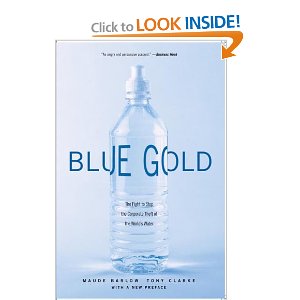
I now realize that this book is a sequel to Blue Gold: The Fight to Stop the Corporate Theft of the World’s Water and I will read and review that book next.
First off, am really starting to pay attention to Right Livelihood, the Alternative Nobel that seems to avoid really big mistakes that have characterized the Nobel Peace Prize in recent decades (Kissinger to Obama). I first learned of this award when Herman Daly, conceptualizer of Ecological Economics, spoke at one of my conferences, and now I am going to look into this and post a listing of recipients at Phi Beta Iota, where all my reviews can be easily exploited across 98 distinct categories, something not possible here at Amazon.
Up front I will still say that Marq de Villier’s Water: The Fate of Our Most Precious Resource is the best book around, along with the The Water Atlas: A Unique Visual Analysis of the World’s Most Critical Resource.
This book joins with Water Wars: Privatization, Pollution, and Profit and its own prequel Blue Gold (now also coming out as a new DVD Blue Gold, along with another DVD, For Love of Water not found, author may have meant instead Flow How did a handful of corporations steal our water) to make the case for water as a human right. The book ends with a Blue Covenent in three parts.
Two points in this book hit me hard:
Read the rest of this entry »
Aug 27

John Perry Barlow
Why Spy?
John Perry Barlow
Forbes, 10.07.02
If the spooks can’t analyze their own data, why call it intelligence?
For more than a year now, there has been a deluge of stories and op-ed pieces about the failure of the American intelligence community to detect or prevent the September 11, 2001, massacre. Nearly all of these accounts have expressed astonishment at the apparent incompetence of America’s watchdogs.
I’m astonished that anyone’s astonished.
The visual impairment of our multitudinous spookhouses has long been the least secret of their secrets. Their shortcomings go back 50 years, when they were still presumably efficient but somehow failed to detect several million Chinese military “volunteers” heading south into Korea. The surprise attacks on the World Trade Center and the Pentagon were only the most recent oversight disasters. And for service like this we are paying between $30 billion and $50 billion a year. Talk about a faith-based initiative.
After a decade of both fighting with and consulting to the intelligence community, I’ve concluded that the American intelligence system is broken beyond repair, self-protective beyond reform, and permanently fixated on a world that no longer exists.
Read full article.
Oct 7

John Perry Barlow
John Perry Barlow is known for being the lyricist for the Grateful Dead, and with Mitch Kapor, co-founder of the Electronic Frontier Foundation (EFF). Howard Rheingold made his acceptance of our invitation to speak conditional on our giving John Perry Barlow time to speak as well, and the rest is history. He nailed it.

Information Wants to Be Free
Dec 25