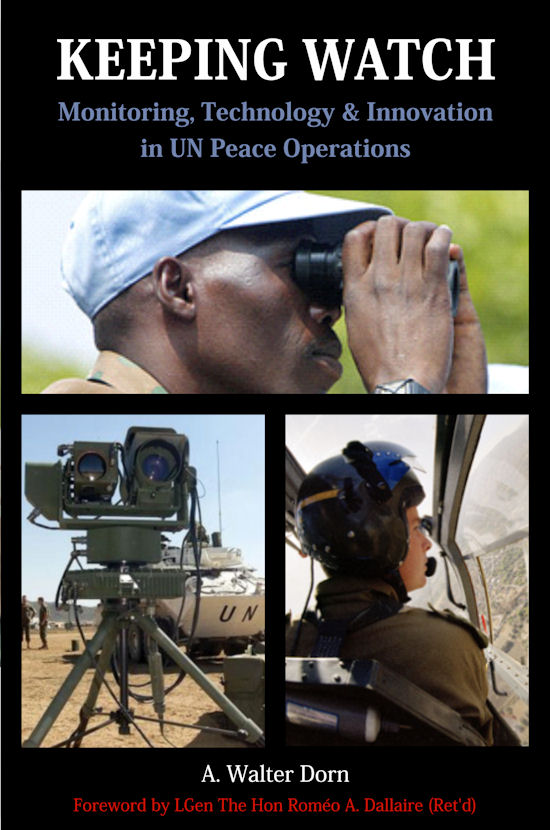
Review: Keeping Watch – Monitoring Technology and Innovation in UN Peace Operations

Tags:

Amazon Page

Walter Dorn

5.0 out of 5 stars Phenomenal Contribution to UN and to Literature,August 13, 2011

Professor Walter Dorn is the de facto dean of the small number of scholars who study the specific topic of peacekeeping intelligence, or intelligence support to United Nations (UN) operations. Since his pioneering early studies of UN successes in the Congo in the 1960′s to his more recent articles on the introduction of the Joint Military Analysis Centre (JMAC) in Haiti, he is both the closest academic observer, and the most well-written in this area.

I read this book with great interest. It is the first comprehensive look at technologies that are directly applicable to the fulfillment of UN mandates, the design and security of multinational forces, the effective management of tactical campaigns, and of course being technical, it is the first and last word on surveillance technologies vital to peacekeeping and peace enforcement across vast regions.

Pending the “Inside the Book” feature being available for this just published book, here is the table of contents from my own copy.

1 Introduction
2 The Evolution of Peacekeeping
3 Monitoring: The Constant Need
4 Survey of Technologies
5 Aerial Surveillance: Eye in the Sky
6 Traditional Peacekeeping: Cases
7 Modern Multidimensional Peacekeeping: Cases
8 Current UN Standards: Starting from Near Zero
9 Challenges and Problems
10 Recommendations
11 Conclusions

I recently attending a conference on the history and future of UN Air Power, and in both my own presentations and those of others, “Peace from Above” was a recurring theme. The importance of assuring that UN elements have the best possible human and technical surveillance technologies cannot be understated–for modest investments–including Unmanned Aerial Vehicles–the UN can save lives, money, and time–on the latter point, Colin Gray, in Modern Strategy, observes that time is the one strategic variable that can neither be purchased nor replaced.

A word on pricing: as those who follow my reviews know, I will occasionally single out extraordinary books that are so grotesquely priced as to dishonor the entire publishing world. This book is perfectly priced, close to my standard of page count with one decimal. I salute the UN Press for bringing this book into the world. It should become a standard volume, not only for UN training classes, but for all war colleges as well as for commercial security training and operations.

See Also:

Peacekeeping Intelligence: Emerging Concepts for the Future

Vote on Review

Comments Off
Aug 13

Reference: UN Air Power Conference Papers

Categories: Briefings (Core)
Tags:

Click on Image to Enlarge

The 17th Air Force Historical Workshop was a great success and the proceedings will be published in book form (scheduled for 2012).

For futher information, please contact Dr. Walter Dorn, Canadian Forces College, Toronto, at dorn@cfc.dnd.ca.

Presentations

Air Operations in Somalia, 1991-1993“,

Dr. William Dean III, United States Air Force Air Command and Staff College

Kinetic Air Power in the Congo, 1961-1963“,

Dr. Walter Dorn, Royal Military College / Canadian Forces College

Attack Helicopters in the Heart of Africa, 2004 onward“,

Dr. Walter Dorn, Royal Military College / Canadian Forces College

United Nations Air Operations in the Congo Crisis, 1960 – 1964“,

Dr. Sebastian Lukasik, United States Air Force Air Command and Staff College
Comments Off
Aug 2

Graphics Directory (List)

Categories: AA Graphics List
Tags: ,

Below the line….alpha list of all graphics [in English] with embedded links. For Spanish-language graphics see AA Lista de Graficas (1) and [in reverse order as posted] AA Espanol (55).  Updated 16 May 2013.

Read the rest of this entry »

Comments Off
Jul 15

Search: dr walterdorn intelligence united nations

Categories: Searches
Tags:

Simplicity matters.  It also helps to not run on the name.  Generally everything on this site bears on intelligence so that is a useless search term in this special context.

Search 1:  Walter Dorn (16 Posts)

Search 2:  United Nations intelligence (over 100 hits most not directly related)

Search 3:  United Nations (over 100 hits slightly more focused)

See Also:

Dorn (under Top Authors Less Steele)

M4IS2

Comments Off
Jun 20

Worth a Look: Keeping Watch (UN Surveillance)

Categories: Worth A Look
Tags:

Click on Image to Enlarge

Amazon Pre-Order Page (Moves in August not December, Amazon Page Has Not Been Properly Set Up By Publisher).

Knowledge is power. In the hands of the UN peacekeepers it can be a power for peace.  Lacking knowledge, peacekeepers often find themselves powerless in the field, unable to protect themselves and others.  The United Nations owes it to both its peacekeepers and the “peacekept” to utilize modern tools to make its monitoring effective for conflict prevention and resolution.

Keeping Watch explains how modern technologies can increase the range, efficiency and accuracy of UN observation.  Satellites, aircraft and ground sensors enable surveillance of large areas over long periods.  They can provide imagery of hot spots for use as evidence in human rights investigations. Sensors can be the extended “eyes” of UN patrols, humanitarian convoys and robust UN operations.  Fortunately, commercial technologies have been increasing exponentially in capability while decreasing rapidly in cost.  The United Nations, however, continues to use technologies and techniques from decades past.

This book identifies the benefits and pitfalls of specific technologies.  The few cases of technologies effectively harnessed in the field are showcased, and creative recommendations are offered to overcome the institutional inertia and widespread misunderstandings about how technology can complement human initiative in the quest for peace in war-torn lands.

A. Walter Dorn teaches military officers and civilians at the Canadian Forces College (CFC) and at the Royal Military College of Canada. He is a professor of defence studies and Chair of the Department of Security and International Affairs at CFC. He has both studied and served on UN peace operations, and worked as a consultant to the UN’s Department of Peacekeeping Operations.

Comments Off
Jun 20

Future of Multinational Intelligence & Operations

Tags: ,

Robert David STEELE Vivas

I am just back from a phenomenal conference on UN Air Operations put together by Professor Walter Dorn and Major Bill March.  The highlight of that event was Senator Romeo Dallaire, LtGen (Ret), author of Shake Hands with the Devil as well as the more recent They Fight Like Soldiers, They Die Like Children.

Here are my notes on points made by Senator Dallaire, followed by some additional  personal views of my own with respect to the future of the UN, NATO, and regional organizations long overdue as stewards of their respective regions peace and prosperity.

+  Drawing on history we can project into the future (not in a linear fashion, but from an informed foundation).  We need to do both, we cannot go on as we are with our short-term perspective.

+  We must achieve a communion of humanity in the larger context of the planet as a whole–this is a grand strategic vision in which nation-states are actually limiting elements.

+  National and regional planning must be integrated into a larger global planning and forecasting process; we must go global.

+  The will to intervene in important, and should be but is not, common sense.  Refugees and displaced persons are vectors for disease and root sources of rage.

Read the rest of this entry »

Comments Off
Jun 19

Call for Papers 31 March UN Aerospace Power

Categories: Uncategorized
Tags:
ON THE WINGS OF PEACE: AEROSPACE POWER IN UN OPERATIONS
Workshop, 15-16 June 2011, Trenton, Ontario

Aerospace power has always been an important element of UN peace operations. At first, aerospace power was limited to transport and basic observation, but the complexity of UN operations has increased the need for support from air and space-based assets. Mission requirements have expanded to include the provision of intelligence, surveillance and reconnaissance (ISR), and when required, the application of force. This workshop will explore the evolution of aerospace power in UN operations past, present, and future.

Individuals wishing to submit a paper for consideration should address it to one of the co-chairs listed below no later than 31 March 2011. Proposals should be at least 200 words in length and include a curriculum vitae (CV). This conference will take place on 15 and 16 June, 2011, at the Canadian Forces Base Trenton, CFAWC, 8 Wing, Trenton, Ontario, Canada.

Dr. Walter Dorn
Canadian Forces College
416-482-6800 x 6539
dorn@cfc.dnd.ca, http://walterdorn.org/events-and-activities

Major Bill March
Canadian Forces Aerospace Warfare Centre
613-392-2811 x 4656
william.march@forces.gc.ca ,

http://www.airforce.forces.gc.ca/CFAWC/AFHWS/AFHWS_2011_e.asp

Comments Off
Feb 6

Event: 15-16 June Ontario UN Aerospace Power

Categories: Uncategorized
Tags:

Click on Image to Expand

ON THE WINGS OF PEACE:

AEROSPACE POWER IN UN OPERATIONS
Workshop, 15-16 June 2011, Trenton, Ontario

Aerospace power has always been an important element of UN peace operations. At first, aerospace power was limited to transport and basic observation, but the complexity of UN operations has increased the need for support from air and space-based assets. Mission requirements have expanded to include the provision of intelligence, surveillance and reconnaissance (ISR), and when required, the application of force. This workshop will explore the evolution of aerospace power in UN operations past, present, and future.

Individuals wishing to submit a paper for consideration should address it to one of the co-chairs listed below no later than 31 March 2011. Proposals should be at least 200 words in length and include a curriculum vitae (CV). This conference will take place on 15 and 16 June, 2011, at the Canadian Forces Base Trenton, CFAWC, 8 Wing, Trenton, Ontario, Canada.

Dr. Walter Dorn
Canadian Forces College
416-482-6800 x 6539
dorn@cfc.dnd.ca, http://walterdorn.org/events-and-activities

Major Bill March
Canadian Forces Aerospace Warfare Centre
613-392-2811 x 4656
william.march@forces.gc.ca ,

http://www.airforce.forces.gc.ca/CFAWC/AFHWS/AFHWS_2011_e.asp

Comments Off
Feb 6

Reference (2): United Nations Intelligence in Haiti

Tags: ,

Peace Operations: Seeing

MajGen Eduardo ALDUNATE Herman, Chilean Army (Ret), served as the Deputy Force Commander of the United Nations Force in Haiti (MINUSTAH) in the earliest rounds, and was instrumental in both sponsoring the Joint Military Intelligence Analysis Center (JMAC) concept in its first modern field implementation, but also in evaluating most critically both the lack of useful intelligence from allies relying on secret sources and methods that did not “penetrate” to achieve gangs and neighborhoods; and the astonishing “one size fits all” propensity of the allies to treat every “threat” as one that could be addressed by force.

His contributions are helpful in understanding the more recent failure of allied relief operations in Haiti that again assumed that the use of armed bodies would address the problem, without making provision for real-world ground truth intelligence (CAB 21 Peace Jumpers Plus) or intelligence-driven harmonization of non-governmental assistance (Reverse TIPFID).

See Also:

Reference: Walter Dorn on UN Intelligence in Haiti

Reference: Civil Military Operations Center (CMOC)

2003 PEACEKEEPING INTELLIGENCE: Emerging Concepts for the Future

Books: Intelligence for Peace (PKI Book Two) Finalizing

Reference: Intelligence-Led Peacekeeping

Review: International Peace Observations

Search: UN intelligence peace intelligence

Comments Off
Nov 28

Who’s Who in Peace Intelligence: Walter Dorn

Tags:

Dr. Walter Dorn

Walter Dorn is an Associate Professor at the Royal Military College of Canada, a senior member of the external faculty of the Pearson Peacekeeping Centre and an Adjunct Research Professor at Carleton University. A physical scientist by training (Ph.D., Univ. of Toronto), he did graduate work on the detection of chemical weapons and on the technical verification of arms control treaties. After graduation, he was a Research Associate of the International Relations Programme of Trinity College (University of Toronto) and a consultant to Yale University (UN Studies).

He served with the UN in East Timor, in Ethiopia, and at UN headquarters as a Training Adviser with the Department of Peacekeeping Operations. He currently teaches courses on peacekeeping and is writing a book titled “Global Watch” on the evolution of UN monitoring.
His new home page provides ready access to his publications, lectures, and longer biography.  Professor Dorn is the de facto “dean” of peace intelligence scholars with deep field experience.

NEW:

Blue Sensors: Technology and Cooperative Monitoring for UN Peacekeeping

Read the rest of this entry »

Jul 24