Definitions: The Basics

Categories: Definitions
Robert Steele

Robert Steele

Robert David STEELE Vivas has committed himself to being intelligence officer to the public, and to the five billion poor in particular, for the balance of his life.

Below are some definitions that matter, as of 1 August 2009 [this is a work in progress, will try to complete it soon, and then future definitions will be separate postings]

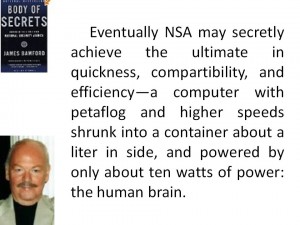
BRAIN: Only a living creature can have a brain, an organic or biological device that has over billions of years evolved to its present state.  The following quotation from James Bamford is instructive; it is the final sentence of his book, BODY OF SECRETS: Anatomy of the Ultra-Secret National Intelligence Agency (page 613)

Human Brain vs. NSA

Human Brain vs. NSA

COLLECTIVE INTELLIGENCE (CI): Collective Intelligence overcomes groupthink and individual cognitive biases by leveraging a process of consensus decision-making that respects–even demands–diversity of inputs and perspetives.  At its best it can be a society of the human mind, achieving conscious evolution as a species.  CI is a return to the precepts ofthe Founding Fathers, and in particular Thomas Jefferson and James Madison.  The industrial era, characterized by Lionel Tiger as “The Manufacture of Evil,” separated the public from both information and elite decision-making, while still taking public money.  Bureaucracy fostered secrecy, and secrecy fostered pathology. Collective intelligence restores the power of the people over their commonwealth, and neutralizes the power of vested interests that manipulate information to concentrate wealth.  NOTE:  a fuller definition that draws on Robert Steele’s many publications can be found at WordIQ, which tends to be more balanced than Wikipedia.  Colloquial terms, each a book title, include Smart Mobs, Groundswell, Here Comes Everybody, Army of Davids, Wikinomics, and Wealth of Networks.

Collective Intelligence

Definition of Collective Intelligence

DATA: The raw direct human observation or articulation, raw image, raw signal, raw signature, or in machine terms, the lowest possible element of information that can be isolated in and of itself with its own provenance.

DATA MINING: The direct exploitation of information already in-hand, or procured for a specific investigation i.e. generally internally-generated and oriented.   Often mis-represented as Business Intelligence.  See also Knowledge Management.  At its best, Data Mining is a huge fraud buster, detecting patterns of import-export tax avoidance, money laundering, and insurance fraud.

DECISION-SUPPORT: The conversion of information, which costs money, into intelligence, which makes money–or achieves other goals, public, and private, of specific interest to a specific individual or body making a decision of import. See also  Intelligence.  An alternative for those organizations such as the United Nations that have long been abused by the confusion of secret sources & methods with the world “Intelligence.”

EARTH INTELLIGENCE (EARTHINT): Earth Intelligence, the subject of a new book (the second book to be published by the Earth Intelligence Network, the first was on Collective Intelligence) is defined by its outcome, the creation of a prosperous world at peace.  We have adopted Buckminster Fuller’s objectives as our own.

The Ultimate Hack

The Ultimate Hack

Read the rest of this entry »

Comments Off
Aug 1

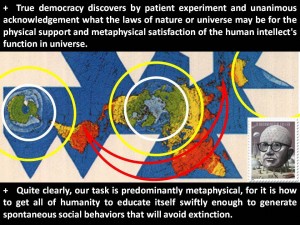
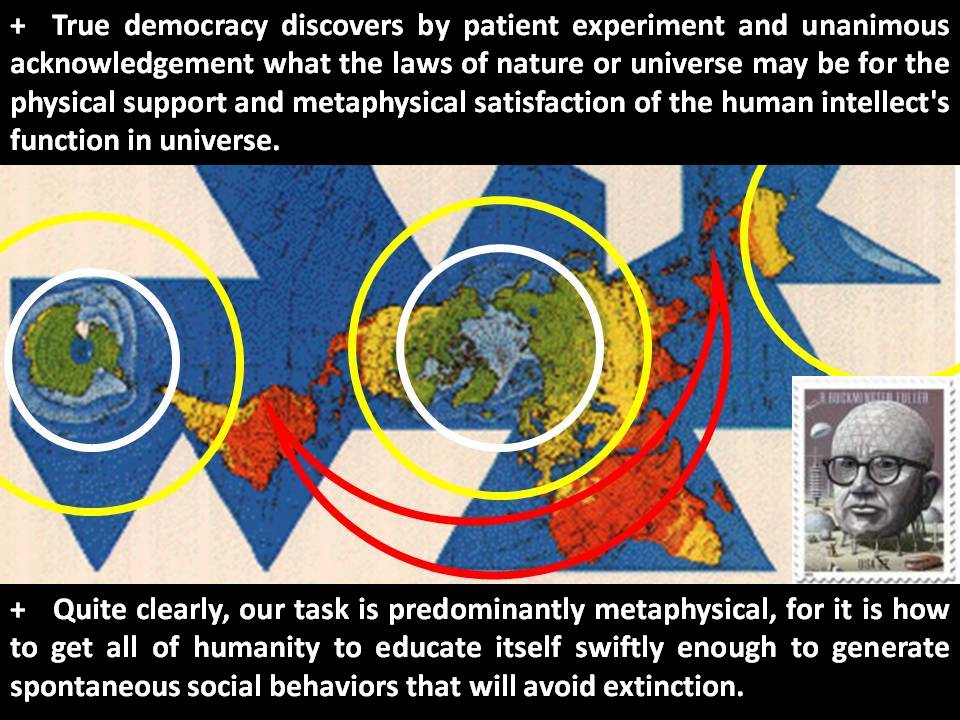
Graphic: Robert Steele Adopts Buckminster Fuller

Tags: ,
Steele Adoption of Fuller

Steele Adoption of Fuller

The pure integral consciiousness of Buckminster Fuller is finally coming into its own as sustainable design, natural capitalism, zero waste, and many other ideas that reflect INTEGRITY as the essence of life, all converge.  Buckminster Fuller is to re-engineering the earth as Will Durant is to re-thinking philosophy.

Comments Off
Jul 13

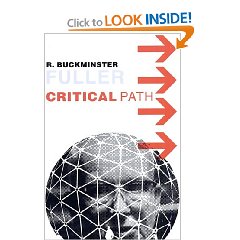
Review: Critical Path

Tags:

Amazon Page

Amazon Page

History, Philosophy, Engineering, Architecture, & Education,

July 13, 2009
R. Buckminster Fuller
Although I heard Fuller speak at Muhlenberg College in 1973 or so, I had not read his books and for me Critical Path was a very healthy reminder that long before many of the current authors, Buckminster Fuller had a grip on the basics:

1) Economic theory of scarcity and secrecy is evil, benefitting the few at the expense of the many

2) Earth is NOT a zero sum Darwinian game for humans, in fact it is the human role–the human mind’s role–to “synergize” Earth into a win-win for all.

3) Money is not wealth only an artifact that is representative of empty bank vaults and gross misrepresentation by the alleged wealthy. Only time-energy accounting and “true cost” of goods and services should be used.

4) Obstacles to displacing rule by scarcity and secrecy are the public ignorance of natural science and the collaboration among governments, corporations and large organizations such as religions and labor unions that “divide and keep conquered.”

5) Computers–and Fuller was clearly envisioning today’s computers, not those of his time–if properly fed all of the relevant data can alter perceptions on a just enough, just in time basis. This coincides with my own view that we can and must educate the five billion poor one cell call at a time, but it also favors the ideas gaining currency of connecting the one billion rich (80% of whom do not give to charity) directly with the needs of the five billion poor at the household level of need.

I am hugely impressed with both specific actionable visions and specific actionable facts:

1) Now possible to create a global electrical grid that runs across Alaska into Canada and China, and eliminate the electrical shortfalls in both those countries and in Canada and the US West Coast.

2) In time-energy “true cost” accounting, every gallon of oil that we use cost $1 million (in 1981 dollars, which is to say, around $10 after the current Administration finished with its massive devaluation plans).

3) There are two critical paths that are not understood by the public or those who profess to represent the public: path one is those natural trends that proceed with or without human errors, omissions, and interventions; path two is the human path both local and as a global aggregate.

4) Considered in time-energy terms, both our industrial-era schools and our industrial-era office buildings are lunacy. He provides a fascinating discussion of inland versus island dwellers, concludes that most urban office buildings should be converted into mixed dwelling-telecommuting centers and is generally brutal about our national policies being 50 years out of date (in 1981–that would make them 80 years out of date today, and I agree).

5) He provides a BRUTAL discussion of banking and government bail-outs of banking as well as mortgage fraud that led to the Great Depression, how banks dispossessed the farmers not realizing that the land was over-valued AND that no one else wanted to do the hard work of farming, and I am generally thunder-struck by how history has repeated itself.

I am especially impressed by his “cosmic costing” which does not allow for hoarding (he joins others in cursing money as both a hoardable good and one that can draw interest beyond reason).

A goodly portion of the book covers the art of doing more with less; doing it faster; and ultimately benefitting increasing numbers of humans with the same technologies.

His discussion of “precession” revolves around not competing with anyone else, instead attending to the unattended. He has a gift for “comprehensive consideration” that we could all draw upon for inspiration.

I am completely absorbed by this book, which includes in the final third:

1) The challenge is to educate all humans, and to teach humans to learn in the shortest possible time–my kids have two answers: cell phones and video games. This is a no-brainer.

2) I offer some quotes below but am totally engaged with his discussion of the Geoscope, what some today might call an Earth Monitoring System, and his view that we can create a 200 foot version of the Earth where one inch equals three miles, and using computers, be able to illuminate for any human–however poorly educated or ideologically stunted–what actually IS the reality.

3) He spends time describing the World Game and cites two books by Medard Gabel that are no longer available via Amazon (but see the EarthGame(TM) technical description offered by Earth Intelligence Network), and describes it as a problem-solving choice-making educational game.

On page 287 I am stunned by his anticipation of the “de-sovereignization” of the United States of America, coincident with the bankruptcy of the US Nation at the hands of its out of control federal government.

On the architectural side I am fascinated by his discussion of flat slab building as the worst possible time-energy construction, and his discussion of the alternatives that he created, including floating cities that I now regard as inevitable.

The book contains an unexpected gem, a compendium created by Fuller based on US contractor experiences in Russia that was delivered to Brazil. It is still valid and it is a model for the kind of clear thinking that government engineers should be able to, but cannot do. [With credit to Chuck Spinney, I have learned that "government specification cost plus engineering" has fried the brains of multiple generations of engineers who are unable to computer biomimicry, cradle to cradle, green to gold, etc. We must wait for our children to rule the world, they are the "digital natives" who will not tolerate rankism, secrecy, scarcity, or lies.

A few quotes are in the comment as I must respect Amazon's 1000 word limit.

Below are some other books that strike me as very complementary of this one, but more recent.
The Fortune at the Bottom of the Pyramid: Eradicating Poverty Through Profits (Wharton School Publishing Paperbacks)
The Landscape of History: How Historians Map the Past
The Philosophy of Sustainable Design
Tragedy & Hope: A History of the World in Our Time
The Health of Nations: Society and Law beyond the State
Rule by Secrecy: The Hidden History That Connects the Trilateral Commission, the Freemasons, and the Great Pyramids
Don't Bother Me Mom--I'm Learning!
Conscious Evolution: Awakening Our Social Potential
Conscious Globalism: What's Wrong with the World and How to Fix It
Information Operations: All Information, All Languages, All the Time

Additional in Comment:

A couple of quotes:

xxv: "It is sa matter of converting the high technology from weaponry to livingry."

xxxvi: "The race is between a better-informed, hopefully inspired young world versus a running-scared, misinformed brain-conditioned, older world."

xxxviii: "The political and economic systems and the political and economic leaders of humanity are not in the final examination; it is the integrity of each individual human that is in the final examination. On personal integrity hangs humanity's fate."

118-119 "The USA is not run by its would-be "democratic" governance.....Nothing could be more pathetic than the role thats has to be played by the President of the United States, whose power is approximately zero."

169 "The objective of the game would be to explore ways to make it possible for anybody and everybody in the human family to enjoy the total Earth without any human interfering with any other human and without any human gaining advantage at the expense of another."

See also page 199, page 202, 208, 221, 225, 287, 346

Simple awesome. If you want your children and grand-children to have an intellectual advantage, nurture their thinking on sustainable development and read in yourself on Buckminster Fuller.

Vote on Review

Vote on Review

Click Here to Vote on Review at Amazon,

on Cover Above to Buy or Read Other Reviews,

I Respond to Comments Here or There

Jul 13

Review: Dignity for All–How to Create a World Without Rankism

Categories: 5 Star,Democracy
Tags:

DignityExcellent Off-Site, Gift, or Personal Improvement Book,June 9, 2009

Robert W. Fuller

I had previously read and reviewed All Rise: Somebodies, Nobodies, and the Politics of Dignity (BK Currents (Hardcover)) and as much as I liked that first book, this is the one I recommend as a broad use item. It is ideal for any company or organizational off-set as a pre-arrival required reading, as a gift (including as an anonymous gift to the rankism-challenged, and as a personal easy to read book.

I myself have been terribly guilty of rankism, primarily in the customer service arena, where mediocre service has roused my fury and I have been less than stellar at realizing that it’s not the person, it’s the system, and so many others are responsible for the mediocrity that I am a fool for taking it out on the one person I can see.

Where this book renders a very useful service is in the naming of the anti-thesis to dignity, i.e. rankism. This is not a book about dignity, but rather about rankism in all its forms and how that robs all of us of dignity, but especially those least able to handle the inequalities including (new term for me) micro-inequalities–the subtle pecking to death by ducks, e.g. being interrupted constantly, not noticed, etc.

I have been focusing on integrity recently, on truth, and I confess that I have not given enough thought to the tact side of the equation. This book is persuasive in saying that truth by itself is not enough, truth must be accompanied by tact, or as I have it in my notes, “Integrity plus dignity = informed democracy.”

There are 24 sidebars, each a little gem, the key points are summarized at the end of each chapter, and I believe this book finally meets the need for a Citizen 101 Guide.

Among my fly-leaf notes:

1. Lack of dignity is a driver toward violence and unreason. This joins a mantra from elsewhere, that anger and violence generally stem from a feeling of being treated unfairly.

2. Dignity should be the first human right.

3. Costs of not providing dignity are enormous. The following is quoted from pages 3-4:

“The consequences of violating others’ dignity are evident in widespread social problems such as high rates of school dropout, prison incarceration, violent crime, depression, suicide, divorce, and despair; in the business world in reduced creativity, lower productivity, or disloyalty to the organization. Even health and longevity areaffected.”

While the above is grossly simplistic, it is important and merits note.

4. Rnakism is the “root” “ism” e.g. for sexism, racism, etc, the one that fosters all other isms by artificially elevating one person over another.

5. Dignitarian intervention breaks the rankism cycle. John Steiner intervened with me one time in Denver, and I have to say that without having read this book, I did not quite see his point. Those intervening should anticipate not being understood the first several times.

6. HUMILITY in leaders signifies an open mind willing to listen to everybody. I have just finished giving up on the leaders of the U.S. intelligence community as they live in “closed circles” and are like Henry Kissinger when David Elsberg counseled him, becoming like morons in that they rely too much on narrow secrets and allow their “closed circle” to shut out all those who actually have ground truth real world experience. See my review of Secrets: A Memoir of Vietnam and the Pentagon Papers

7. The vignettes are not to be skipped. As impatient a reader as I am, I realized after a few of them that they comprise in the aggregate a 360 degree repetition of the basic lesson in many more naunced ways.

8. Secrecy and silencing are part of the Borg as I have tekn to calling it, the “establishment” in which neither Bush nor Obama really controls anything, the “system” goes on with its Wall Street ubber alles and two parties doing the bidding of special interests. Snobbery (think Council on Foreign Relations), bullying (think clearances removed from whistle-blowers) and blackballing (think CIA never hiring anyone critical of their nonsense) are all part of the Borg.

9. The book ends with comments on truth and reconciliation, of which I am a huge fan, believing the USA needs at least two–one for what has been done to We the People including our Native Americans and people of color, another for what has been done around the world “in our name” and at our expenses. Appreciative inquiry is discussed, as well as shared governances and shared evaluation.

Bottom line: this may well be the one book and the one idea that We the People cannot do without.

I also recommend:
The Tao of Democracy: Using Co-Intelligence to Create a World That Works for All
Society’s Breakthrough!: Releasing Essential Wisdom and Virtue in All the People
The New Golden Rule: Community And Morality In A Democratic Society
Communitas: Means of Livelihood and Ways of Life
Orbiting the Giant Hairball: A Corporate Fool’s Guide to Surviving with Grace
We the Purple: Faith, Politics, and the Independent Voter
Blessed Unrest: How the Largest Social Movement in History Is Restoring Grace, Justice, and Beauty to the World
Collective Intelligence: Creating a Prosperous World at Peace

Comments Off
Jul 3

Review: Operating Manual for Spaceship Earth

Tags:

Amazon Page

Amazon Page

Not What I Expected But Hugely Satisfying,

June 27, 2009

R. Buckminster Fuller

I was actually expecting an Operating Manual. Although what I ended up with is a 136-page double-spaced “overview” by Buckminster Fuller, a sort of “history and future of the Earth in 5,000 words or less, bracketed by a *wonderful* introduction by grandchild Jamie Snyder, an index, a two-page resource guides, and some photos and illustrations including the Fuller Projections of the Earth.

First, the “core quote” that I can never seem to find when I need it:

OUR MISSION IS “To make the world work for 100% of humanity in the shortest possible time through spontaneous cooperation without ecological offense or the disadvantage of anyone.” Inside front cover.

The introduction is a treat–I note “impressive” and appreciate the many insights that could only come from a grandchild of and lifelong apprentice to Buckminster Fuller.

Highlights for me:

Founder of Design Science, a company by that name is now led by Medard Gabel who served as his #2 for so long. I just attended one of their summer laboratories and was blown away by the creativity and insights. It is a life-changing experience for those with a passion for Earth.

He imagined an inventory of global data. I am just now coming into contact with all of this great man’s ideas, but my third book, Information Operations: All Information, All Languages, All the Time, also online at the Strategic Studies Institute in very short monograph form, is totally in harmony with this man’s vision for a global inventory of global data.

“Sovereignness” was for him a ridiculous idea, and a much later work out of Cambridge agrees, Philip Allot tells us the Treaty of Westphalia was a huge wrong turn in his book The Health of Nations: Society and Law beyond the State.

“Great Pirates” that mastered the oceans as the means of linking far-flung lands with diversity of offerings was the beginning of global commerce and also the beginning of the separation between globalists who knew the whole, and specialists whom Buckminster Fuller scathingly describes as an advanced form of slave.

He was frustrated with the phrases “sunrise” and sunset” as they are inaccurate, and finally settled for “sunsight” and “suneclipse” to more properly describe the fact that it is the Earth that is moving around the sun, not the other way around.

In 1927 he concluded that it is possible for forecast with some accuracy 25 years in advance, and I find this remarkably consist with Senator Daniel Patrick Moynihan’s view that it takes 25 years to move the beast–see for instance Miles to Go: A Personal History of Social Policy.

He has an excellent discussion of the failure of politics and the ignorance of kings and courtiers, noting that our core problem is that everyone over-estimates the cost of doing good and under-estimates the cost of doing bad, i.e. we will fund war but not peace.

He described how World War I killed off the Great Pirates and introduces a competition among scientists empowered by war, politicians, and religions. He says the Great Pirates, accustomed to the physical challenges, could not comprehend the electromagnetic spectrum.

He states that man’s challenge is to comprehend the metaphysical whole, and much of the book is focused on the fact, in his view, that computers are the salvation of mankind in that they can take over all the automaton work, and free man to think, experiment, and innovate. He is particularly forceful in his view that unemployed people should be given academic scholarships, not have to worry about food or shelter, and unleash their innovation. I am reminded of Barry Carter’s Infinite Wealth: A New World of Collaboration and Abundance in the Knowledge Era as well as Thomas Stewart’s The Wealth of Knowledge: Intellectual Capital and the Twenty-first Century Organization.

There is a fascinating discussion of two disconnected scholars, one studying the extinction of human groups, the other the extinction of animal species, and when someone brings them together, they discover that precisely the same cause applied to both: over-specialization and a loss of diversity.

Synergy is the uniqueness of the whole, unpredictable from the sum of the parts or any part individually.

On page 87 he forecasts in 1969 when this book was first published, both the Bush and the Obama Administration’s ease in finding trillions for war and the economic crisis, while refusing to recognize that we must address the needs of the “have nots” or be in eternal war. I quote:

“The adequately macro-comprehensive and micro-incisive solutions to any and all problems never cost too much.”

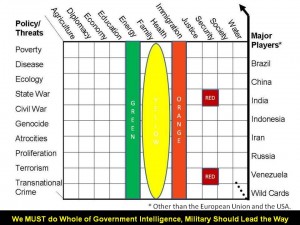
I agree. I drove to Des Moines and got a memo under Obama’s hotel door recommending that he open up to all those not represented by the two party crime family, and also providing him with the strategic analytic model developed by the Earth Intelligence Network. Obviously he did not attend, and today he is a pale reflection of Bush. See the images I have loaded, and Obama: The Postmodern Coup – Making of a Manchurian Candidate.

Early on he identified “information pollution” as co-equal to physical pollution, I am totally taken with this phrase (see my own illustration of “data pathologies” in the image above). I recognize that Buckminster Fuller was about feedback loops and the integrity of all the feedback loops, and this is one explanation for why US Presidents fail: they live in “closed circles” and are more or less “captive” and held hostage by their party and their advisor who fear and block all iconoclasts less they lose their parking spot at the White House.

Most interestingly, and consistent with the book I just read the other day, Fighting Identity: Sacred War and World Change (The Changing Face of War), he concludes that wars recycle industry and reinvigorate science, and concludes that every 25 years is about right for a “scorched earth” recycling of forces.

He observes that we must preserve our fossil fuels as the “battery” of our Spaceship Earth, and focus on creating our true “engine,” regenerative renewable life and energy.

He joins with Will Durant in Story of Philosophy: The Lives and Opinions of the World’s Greatest Philosophers: education is our most formidable task.

I am astonished to have him explain why the Pacific coast of the US is so avant guarde and innovative (as well as loony). He states that the US has been a melting pot for centuries, and that the West Coast is where two completely different cultural and racial patterns integrated, one from Africa and the east, the other from the Pacific and the west.

I learn that he owned 54 cars in his lifetime, and kept leaving them at airports and forgetting when and where. He migrated to renting, and concluded that “possession” is burdensome.

See also:
Ecological Economics: Principles And Applications
Plan B 3.0: Mobilizing to Save Civilization (Substantially Revised)

Vote for Review

Vote for Review

Comments Off
Jun 27

Graphic: Medard Gabel’s Cost of Peace versus War

Tags: ,
Medard Gabel

Medard Gabel

Medard Gabel, #2 to Buckminster Fuller in creating the analog World Game, is the creator of the EarthGame, trademarked in his name and the foundation for the Earth Intelligence Network vision of creating a World Brain that allows for 24/7 panarshy–all minds, all information, all the time.  Visit Medard at his logo on the left.  Read his high-level summary of how inexpensively he can create the EarthGame at Frog right.

logo-BPSW_web_banner_2009

EarthGame

EarthGame

Comments Off
Aug 15

Review: New Turkish Republic–Turkey As a Pivotal State in the Muslim World

Tags:
Turkish Republic

Amazon Page

Undergraduate Overview, Superb Price, a Real Value, May 4, 2008

Graham Fuller

I might have made this a four star since it is missing a couple of big pieces, but the overall book is so well presented in summary form, and the publisher has made it so reasonably priced, this would appear to be exactly the kind of book that is ideal for both the undergraduate and the graduate whom might be beginning a more intensive look at Turkey in its new “360 degrees” or Ankara-centric re-emergence as both a regional power and a continental power.

No Turks in, of, and for Turkey are on the credits, which confirms my first impression that this is a superb primer of, by, and for American students, but the US Institute of Peace is the publisher, so I get over it. Still, the book does not address the Muslim world outside the immediate region, and I am immediately irritated by the early depiction of Paul Wolfowitz as a proponent of democracy in Iraq–Wolfowitz lied to Congress and the public, and is no more a proponent of democracy anywhere than I am in favor of making Islam the ruling religion in America.

Having said that, the author’s commitment and knowledge cannot be denied, and I found this book totally worthy of my time. I learned from it.

+ Turkey *is* a part of the Middle East, but ignored it up through the 1990′s and did not settle its border with Syria until 2004.

+ Turkey, not Saudi Arabia or any other pretender, has been the center of the Muslim world (the Caliphate) for six centuries, and as the center of the Ottoman empire was the protector of the Holy Places.

+ The author asserts that Turkey is the most advanced secular and democratic state in the Muslim world. Huh? Coming out of an era of military dictatorships, and never mind Malaysia, Indonesia, or India (second largest Muslim population after Indonesia)? Not so fast!

+ While the author sets forth a key question, will Muslims embrace democracy, I point the reader to Who Speaks For Islam?: What a Billion Muslims Really Think and the finding in that book that most Muslims consider democracy to be a FOREIGN concept.

+ The author shocks early on in pointing out that Turks consider the USA to be the TOP THREAT to Turkey. I begin to realize the author has delicately folded major truths in, with a minimalist pandering to the jerks that are still in power (or seeking power one last time before they run out of Depends diapers for adults).

+ No one in the White House or anywhere else in the USG is likely to read this book (less well-intentioned Foreign Area Officers on their way there) so I regard the book as a useful cautionary tale for all of us. The neoconservatives took Turkey for granted, offended Turkey, and are so visibly amoral and inept as to inspire contempt from Turkey, a contempt I certainly share. As the author puts it, we are “treading water” with Turkey (as a time when they should be one of our “top ten” for deep engagement).

+ The author tells us that Turkey abolished the Caliphate in 1924, and that this was a body blow to Islam. In a brilliant analogy, he says that this would be the equivalent of an Italian Prime Minister abolishing the Papacy without consulting Catholics worldwide, and doing so as a snap decision.

+ The author illuminated the Turkish intellectual vision of state, faith, and modernity being compatible, and provides two very valuable pages on t he Abant Forum for intellectual tolerance and inquiry.

+ A great deal of the book is undergraduate level brevity (e.g. the Iran-Iraq war gets one paragraph at a time when Turkey was a major adjacent party).

+ Among the prices of the Cold War (see my review of The Fifty-Year Wound: How America’s Cold War Victory Has Shaped Our World was the disconnection of Turkey from the Middle East and the Arabs, making is a client state of the USA in unwelcome and ultimately unwise ways.

+ The author teaches me that the Kurdish revolutionaries and separatists, the PKK (Partiya Karkeren Kurdistan, or Kurdish Workers Party) are a problem in Syria and Iran as well as Iraq and Turkey. I gain the impression that Turkey will do just about anything to prevent a free Kurdistan, but I also wonder in Kurdistan and Palestine are two areas that could be turned into zones of peace and development.

+ On that note, I learn that Palestine was part of the Ottoman empire, and that the Sultan was the Protector of Holy Places.

+ I am deeply engaged by the author’s discussion of Islamic banking, and Turkish concerns that the Saudi regime is using increased focus on this as a means of reinforcing Islamic forces within Turkey.

+ I learn that Turkey is pursuing a regional strategy of “no enemies” and has a foreign policy strategy of “proactive peace.” Wow. This is seriously good stuff, and it shames me that America cannot rise to this level of sophistication and future-focus.

+ I learn that four of the five Central Asian states are Turkic, and that after the USA and Russia, China is Turkey’s major concern, in part because the Uyghurs are Turkic. Has the USA ever had a Turkic strategy or a Caliphate strategy? Highly doubtful.

+ The author states that the Turks are suspicious of Saudi international policies, and I wonder why there is no deeper discussion, especially since it is now widely known that the Saudi dictatorship has been funding Bin Laden, rote-learning madrasses, and total hate crimes against Shi’ites (15%, with Iran as the only state).

+ He says that Turkey has a strong commitment to Afghanistan, but here I have a note, “too much avoidance.” This is an excellent book and easily understandable by an undergrad, but it needs a couple more chapters (one on Saudis as enemies of Muslim stability world-wide, another on Turkey and the non-Arab Muslim states), and a decent bibliography with a 360 view of competing authorities.

+ He tells us the Kurds have entered mainstream Turkish politics, including election to their Parliament, but I am skeptical and wondering if there is not a really big deal to be cut that runs from Turkey to Kurdistan and Lebanon to Palestine–the three trillion we have wasted in Iraq could have resurrected America AND paid for a massive Marshall Plan for the region.

+ The US chapter is vital. It will never be read by those that make their own idiotic reality, but for the rest of us, it is a fine tale of friction, opportunity lost, a lack of sufficient respect, and more. This is a really good and really important chapter.

The book concludes that Turkey has three choices: continue to be US centric, become Europe centric and join the European Union, or return to Ankara centric, with 360 interests and responsibilities in all directions. I am truly inspired by this book, and in the future will factor Turkey in as co-equal to Brazil, China, Indonesia, India, Iran, Russia, and Venezuela.

Bottom line: this book was a real pleasure to read as an adult hooked on respecting reality, and I strongly recommend it for both teaching at any level, and for anyone interested in what is clearly a major player in the 21st Century. On balance, this book respects Turkey in a very sincere and useful way, while delicately calling out the USA (under all recent Administrations of either party) for being distant, dumb, inattentive, and generally stupid. I am reminded of Daniel Elsberg lecturing Kissinger on how one becomes like a moron the higher up the secret classification scale you go, thinking you know more secret, and becoming unwilling to listen to those with their feet on the ground and decades of eyes and ears on and in place. See my review of Secrets: A Memoir of Vietnam and the Pentagon Papers.

Other recommended books:
The Looming Tower: Al Qaeda and the Road to 9/11 (Vintage)
Web of Deceit: The History of Western complicity in Iraq, from Churchill to Kennedy to George W. Bush
Legacy of Ashes: The History of the CIA
Crossing the Rubicon: The Decline of the American Empire at the End of the Age of Oil
The Sorrows of Empire: Militarism, Secrecy, and the End of the Republic (The American Empire Project)
Islamic Leviathan: Islam and the Making of State Power (Religion and Global Politics)
Good Muslim, Bad Muslim: America, the Cold War, and the Roots of Terror

Vote on Review

Comments Off
May 4

Review: All Rise–Somebodies, Nobodies, and the Politics of Dignity

Tags:

All RiseManfiesto for Transpartisan Democracy and Moral Capitalism,

April 20, 2007

Robert W Fuller

Over the many years, roughly 3,000 books of which 850+ have been reviewed here at Amazon, with a few exceptions all of the authors at the top of their game, I have never encountered a book quite so straight-forward or quite so vital to our future. At 54, I simply did not understand the fundamentals of “all men are created equal” until this author pointed me to the one word I was missing: “dignity.”

This book is nothing less than revolutionary, nothing less than the manifesto for the new politics of transpartisanship and being developed by Don Beck and Jim Turner and Reuniting America (80 million strong and growing).

At the very highest level, the author suggests that “rankism” or the abuse of rank, not to be confused with the proper use of rank and authority for the good of the group, is an umbrella term that encompasses racism, sexism, fascism, and even (I add) fundamentalism that excludes “the others” and offers an almost cult-like sense of belonging to the “initiated.” We are all in this together, and with one word, DIGNITY, the author has completely shredded all excuses for abusing others, and opened the door for a new politics of one for all and all for one. The Republican and Democratic parties are, in my personal view, toast. Not their individual candidates, mind you, but the two parties, both of which violated their Article 1 responsibilities for keeping the White House in check, both of which have treated “the other” party as the enemy, with arrests, venomous attacks, slander, and other monstrous behavior.

Norman Cousins and his book, “The Pathology of Power” is still the best all-around dissection of the corrupt nature of unchecked power, but this book is in my view the single best lifeline for those who would seek to embrace bottom-up power, the power of the We, the Us, the collective intelligence of everyone from janitor to Epoch B swarm leader.

As an intelligence professional, and as an estranged moderate Republican who did what he could to oppose the war on Iraq based on lies from Dick Cheney and Paul Wolfowitz, I found the author to be utterly compelling and relevant when he reviewed how rankism silences or ignores dissent, and consequently leads to disaster. His examples are brilliant, from the shuttle disasters to nuclear power plant short-cuts that have almost led to Chernobyl-level melt-downs in the USA.

Bottom line: the dignitarian approach dramatically increases the chances that we will get a particular policy or budget or process RIGHT.

The author teaches us that insulting behavior from above is a precursor to exclusion, abuse, and I would add, genocide–see the work of Dr. Greg Stanton on the web. Isolating any one group is the first step in making them “sub-human” and thus acceptable as targets for mass murder.

I worked hard in the 1980′s to shift the US Government away from its focus on military hardware geared to the Soviets and Chinese, and toward what General Al Gray, then Commandant of the Marine Corps, called “peaceful preventive measures.” I am warmed and impressed as this author makes the point that “dignity for all” is the ONLY “pre-emptive” strategy that will work both at home and abroad. See my reviews of “Class War,” “Working Poor,” “Rogue Nation,” “Confessions of an Economic Hit Man” and “The Soul of Capitalism” for a broader understanding of how all that our American leaders are disgracing America and making us less safe.

The author tells us that DIGNITY respects every contribution at every level. From this I take dignity to be the foundation for TRANSPARTISANSHIP, which embraces all individuals while recognizing that “Unity08″ like the takeaway of the debates from the League of Women Voters, is a thinly guised effort to keep the two-party spoils and pork system alive.

The author teaches us that dogma is neither dignified nor sacrosanct. It is the opposite of dignity.

The author devotes an entire chapter to the importance of creating new models of understanding, something that humans are uniquely qualified to both do, and communicate and discuss.

He teaches us that humility is essential to an open mind, and essential to successful leadership. I fear that I have been lacking in this area my entire life, but now I embrace this term and am moving forward.

The author equalizes the role of the experts (who we learn are wrong 45% of the time in “The Wisdom of the Crowd” and the end-users, the citizens.

The author brings together and simplifies an entire literature in four ideas: shared governance; 360 degree reviews and evaluations, collaborative problem solving, and–this is huge–CONSTITUTIONAL reviews every five to ten years. Henry Kissinger in “Does American Need a Foreign Policy” and General Tony Zinni in his most recent book both tell us that our current government is DYSFUNCTIONAL. In my view, the most dysfunctional aspect is the “winner take all” approach to both the Cabinet and to Congressional leadership positions. We need a COALITION government that restores both the balance of power and the balance of ideas.

The author tells us that when authority loses credibility, the ship of state is on the rocks. See Max Manwaring’s “The Search for Security” and Will and Ariel Durant’s “The Lessons of History” to understand why legitimacy and morality, respectively, are the non-negotiable foundation for our future.

The author provides 10 ways to combat rankism, and provides a 17 item conclusion as a guide for leaders. Finally, the author joins with the relatively recent declaration of the United Nations, to wit, that sovereign nations should NOT be allowed to violate human rights, a universal right. On this see Philip Alcott’s extraordinary book, “The Health of Nations.”

The author errs in identifying only 1 billion in poverty. Not only is the number five billion. See C.K. Prahalad in “The Fortune at the Bottom of the Pyramid.”

This author and this book save our Republic and the world with one word: DIGNITY.

The Pathology of Power
The Global Class War: How America’s Bipartisan Elite Lost Our Future – and What It Will Take to Win It Back
The Working Poor: Invisible in America
Rogue Nation: American Unilateralism and the Failure of Good Intentions
Confessions of an Economic Hit Man
The Soul of Capitalism: Opening Paths to a Moral Economy
The Search for Security: A U.S. Grand Strategy for the Twenty-First Century
The Lessons of History
The Health of Nations: Society and Law beyond the State
The Fortune at the Bottom of the Pyramid: Eradicating Poverty Through Profits

AA Mind the GapClick Here to Vote on Review at Amazon,

on Cover Above to Buy or Read Other Reviews,

I Respond to Comments Here or There

Apr 20