Worth a Look: Davos 2010 – MIT Collective Intelligence

Categories: Uncategorized
Tags:

YouTube 4 minute 13 second Thomas Malone at Davos on emerging Collective Intelligence.

His bottom line:  Human + Computers Converging toward a single global brain, eventually we may be able to harness global collective intelligence.

See also:

What is collective intelligence and what will we do about it?

2008 World Brain as EarthGame

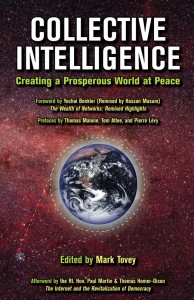
2008 COLLECTIVE INTELLIGENCE: Creating a Prosperous World at Peace

Read the rest of this entry »

Comments Off
Feb 7

Who’s Who in Collective Intelligence: Thomas Malone

Tags:
Thomas Malone

Thomas Malone

Thomas W. Malone (http://cci.mit.edu/malone/) is the Patrick J. McGovern Professor of Management at the MIT Sloan School of Management. He is also the founder and director of the MIT Center for Collective Intelligence and author of the book The Future of Work. Professor Malone has published over 75 articles, research papers, and book chapters; he is an inventor with 11 patents; and he is the co-editor of three books: Coordination Theory and Collaboration Technology, Inventing the Organizations of the 21st Century, and Organizing Business Knowledge: The MIT Process Handbook. For further information about the Center, please visit: http://cci.mit.edu.

Professor Malone opens the book at page one.

What is collective intelligence and what will we do about it?

The Book

The Book

Comments Off
Jun 19

Review: The Future of Work–How the New Order of Business Will Shape Your Organization, Your Management Style and Your Life (Hardcover)

Tags:

Amazon Page

Amazon Page

4.0 out of 5 stars Light, Western-bias, but worthwhile,

November 11, 2005
Thomas W. Malone
The bottom line in this book is on page 33, with a table showing how the cost of moving a page of text around the world and to an infinite number of people has gone from astronomical to zero. In the author’s view, this changes everything.

The book is somewhat shallow, written for undergraduates, and very western in bias–as I ranted to Interval in 1993 (“God, Man, and Interval” easily found via Google), until these benefits can reach every impoverished individual in the world, so that they can begin using information access to create wealth, then we are simply in isolation.

Interestingly, the zero cost of communications comes at the same time that we pass the “peak oil” point and the end of cheap oil, the end of free water, and the rise of pandemic disease.

In that vein, I give the author high marks, taking the book to 4 stars from 3, for his emphasis on values. There is an ethical underpining to this book that is helpful. There is a broad literature, some recognized by the author, others not, that suggests that we made a very serious mistake when we disconnected work from kinship, and commoditized the human employee. The gutting of the pension funds and the destruction of local production in the face of Wal-Mart using cheap oil to ship US jobs overseas are just the latest examples of how our loss of perspective and ethics at the top of the food chain has hurt our economy and our people.

I believe that the author is on target with his emphasis on communications, but he does not address the other half of the equation, “sense-making” or collective intelligence. For that aspect I recommend Howard Rheingold’s “Smart Mobs,” and Tom Atlee’s “The Tao of Democracy.” General Alfred M. Gray, then Commandant of the Marine Corps, drove this point home to Congress in the late 1980′s when he said that the Marine Corps, alone among the military services, had communications and intelligence under the same flag officer “because communications without intelligence is noise, and intelligence without communications is irrelevant.” You need both.

One important point the author does not cover since he avoids addressing the needs of the Third World is this: the Department of Defense has enormous stores of abandoned communications satellite “residual capability,” that last 10-20% of a satellite that has been junked in favor of a newer fancier model. My Air Force colleagues tell me that a national project to make that capability available free could support T-1 connectivity across Africa, South Asia, the Caribbean, Central America, and South America.

Unfortunately, the U.S. Government is not yet in the information age, and not yet able to realize that it is Internet connectivity to all, not guns over all, that will bring peace and prosperity to the Earth. I do believe this author understands that, and I hope he expands his vision to embrace intelligence, and global access.

Vote on Review

Vote on Review

Comments Off
Nov 11

Warning: Unknown: failed to open stream: No such file or directory in Unknown on line 0

Fatal error: Unknown: Failed opening required '/data/16/1/35/61/1850387/user/2008605/cgi-bin/root.ini' (include_path='.:/usr/services/vux/lib/php') in Unknown on line 0