
Arno Reuser: Google Search Reference Sheet
Uncategorized
search language Google.com quick reference sheet
Editted: 15oct2014
Posted with permission.
http://www.
Robert Steele: How Dutch Intelligence Survived & Prospered Using Open Source Human Intelligence as a Foundation for Ethical Evidence-Based Decisions
Advanced Cyber/IO, Ethics, Government
Click on Image for Bio Page
These are my words, reflecting what I learned in multiple funded trips to work with Dutch intelligence at various levels, and multiple conversation across various conferences I attended in Europe. This is more or less what I told George Tenet when he became DCI….to no effect, naturally.
1994 was a very stressful time in Dutch intelligence history. A scandal had erupted in which the Parliament was investigating Dutch intelligence intrusions with audio-video into the homes of specific Dutch citizens suspected of this and that. Parliament was so angry they threatened to cut all funding for all intelligence. Two very good things emerged from this:
Future of the Library versus Future of the Librarian
Advanced Cyber/IO, Communities of Practice, Cultural Intelligence, info-graphics/data-visualization, IO Mapping, IO Multinational, IO Sense-Making, Methods & Process, Policies, Threats
The future of the library
What is a public library for?
First, how we got here:
Before Gutenberg, a book cost about as much as a small house. As a result, only kings and bishops could afford to own a book of their own.
This naturally led to the creation of shared books, of libraries where scholars (everyone else was too busy not starving) could come to read books that they didn't have to own. The library as warehouse for books worth sharing.
Only after that did we invent the librarian.
The librarian isn't a clerk who happens to work at a library. A librarian is a data hound, a guide, a sherpa and a teacher. The librarian is the interface between reams of data and the untrained but motivated user.
After Gutenberg, books got a lot cheaper. More individuals built their own collections. At the same time, though, the number of titles exploded, and the demand for libraries did as well. We definitely needed a warehouse to store all this bounty, and more than ever we needed a librarian to help us find what we needed. The library is a house for the librarian.
Continue reading “Future of the Library versus Future of the Librarian”
Worth a Look: Arno Reuser OSINT Wizard
Methods & Process, Worth A Look
We came across this while trolling for worthwhile new stuff on OSINT; finding none, we thought to post this as a reminder that the OSINT Wizard lives and works in The Netherlands, and is open for business.
Remember the two cardinal rules:
1. Governments are the beneficiaries of OSINT done by others, not the benefactors.
2. OSINT is the old new idea. It still needs development, but the new new idea is M4IS2.
Rumor has it that Reuser and Steele will be doing something together, very dangerous, very hush hush…..tell no one.
2014 Handbook Online for Internet Tools and Resources for Creating Open Source Intelligence (OSINT) by Dr. Ran Hock, Chief Training Officer, Online Strategies, Inc.
Historic Contributions, IO Tools, OSINT Generic
PLATINUM LIFETIME ACHIEVEMENT, Dr. Ran Hock
Dr. Ran Hock has done more than any single individual to educate both government and private sector parties with respect to the value of the deep web. He has single-handedly trained hundreds of individuals in the nuances of this major new intelligence resource base. Emphasizing individual analytic skills and common sense rather than arcane expensive and generally unproductive technologies, he represents the intersection of integrity, intelligence, and intuition in the service of all legitimate governments and organizations.
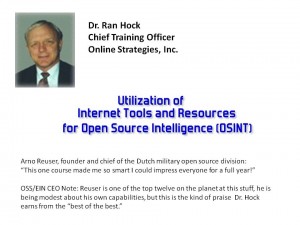
The blurb from Arno Reuser, founder and chief of the Dutch military open source intelligence division, says essentially that attending Ran Hock's course once a year made him look smart for the entire year. Arno is a master librarian and a giant in the field, he is being modest, but this is the kind of praise that Ran Hock's earns from the “best of the best.”
See Also:
- Handbooks(64)
- Analysis (13)
- C4/JOE/Software (4)
- HUMINT (11)
- Law Enforcement (12)
- Military (19)
- OSINT Generic (17)
- Stabilization (19)
- Threats/Topical (13)
- UN/NGO (19)
Search: OSINT software
Analysis, Augmented Reality, Budgets & Funding, Collaboration Zones, Collective Intelligence, Communities of Practice, Computer/online security, Counter-Oppression/Counter-Dictatorship Practices, Cyberscams, malware, spam, Ethics, Geospatial, InfoOps (IO), International Aid, Key Players, Methods & Process, Policies, Searches, Strategy, Technologies, Threats, Tools, True CostThe search term brings up appropriate results, but the fact of the search gives us an opportunity to provide comment.
1) Nothing now being used by governments, and certainly not iBase or Palantir, both aging technologies that do not scale and have too many fat-finger handicaps, fulfills the originial requirements documents crafted in the late 1980's.
Worth a Look: 1989 All-Source Fusion Analytic Workstation–The Four Requirements Documents
2) The ONLY programs that have gotten anywhere close are COPERNICUS plus plus, and SILOBREAKER. However, both of these have been slow to recognize the urgency of integrating–fully integrating–capabilities that address each of the eighteen functionalities. Below is the list of softwares now in use by US Special Operations Command J-23 Open Source Intelligence Branch along with the STRONG ANGEL TOOZL and a couple of other things.
Memorandum: USSOCOM Software List and STRONG ANGEL TOOZL
See also:
Search: The Future of OSINT [is M4IS2-Multinational]
Worth a Look: Deep Web Multilingual Federated Search
1988-2009 OSINT-M4IS2 TECHINT Chronology
Worth a Look: Planetary Skin Data Sharing Initiative
Who’s Who in Librarian Intelligence: Arno Reuser
Who’s Who in Public Intelligence: Mats Bjore
Who’s Who in Collective Intelligence: Stephen E. Arnold
Journal: Dr. Dr. Dave Warner Shares…
Review: The Starfish and the Spider–The Unstoppable Power of Leaderless Organizations
Review: Innovation Happens Elsewhere–Open Source as Business Strategy
Journal: Google, the Cloud, Microsoft, & World Brain
Worth a Look: GeoChat (SMS Plotted on Map)
1998 Arnold (US) New Trends in Automated Intelligence Gathering Software
The global standard for multinational information-sharing and sense-making is in the process of being designed, funded, and distributed. If you think you have something relevant to that, generally only open source software will be considered, get in touch with any of the individuals above.
