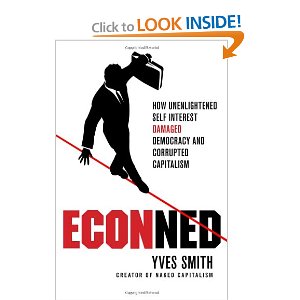
Review (Guest): ECONned – How Unenlightened Self Interest Undermined Democracy and Corrupted Capitalism

Tags:

Amazon Page

Yves Smith

5.0 out of 5 stars ECONNED,March 3, 2010

M. M. Thomas (Brooklyn) – See all my reviews

I’ve written quite a bit about the financial crisis, and God knows I’ve read nearly every book on the subject, and I have no hesitation in saying that if there is one book that gets it whole, and gets it right, and is THE book for the intelligent, thoughtful reader to turn to, it is ECONNED. This is not an anecdotal recitation of deal gossip (like, for example, Sorkin’s book); it’s not “source-based” journalism reflective of the way certain participants in the dire events that unfolded in 2007-2009 wish themselves to be seen. It lays out, in what is easily as clear, as direct, as smart and with as much force of fact as any financial writing today how exactly the fun and games that have nearly wrecked our economy and the lives of so many of us went down. Yves Smith is, unlike so many other writers feeding off the crisis, writing about it from the inside: with an unfailing grasp of where the details (where the devil lurks) fit into the larger pattern of financial perfidy and destruction, in this Doomsday Machine that Wall Street put together. The intelligent reader will understand that if you want to know why you’re suffering from acute ptomaine, you have to understand what went into the sausage you got it from. And then you have to be made to see plain the kind of restaurant or market that serves up this toxic offal. And then the regulatory failures that allow such places to be licensed. We have undergone one of the great crises in this nation’s history. It needs to be seen plain and understood. Deadline-driven blahblahblah won’t get the job done. But ECONNED does. I cannot recommend it highly enough.

Vote and/or Comment on Review

Comments Off
Jan 23

Journal: Get America Working–A Conversation Part II

Original Post with William Drayton, Alexandere Carpenter, and Robert Steele:  Journal: Get America Working–A Conversation

Part II–Alexander Carpenter (AC), the Founding Fathers, and Modern Seers

Journal: Get America Working-A Conversation

If you do nothing else, please consider reviewing the many contributions by Tom Atlee via the first line in Part IV: Related Recommended Reading,

Atlee at Phi Beta Iota

AC: And add this from Charles Hugh Smith to the list:

Charles Hugh Smith America’s Job-Creation Machinery Is Hollowed Out

Dave Cohen on Job Prospects in the Bubble Economy, looking for a technological driver:

And this for those still trying to believe in the “enlightenment model,” some lowest-common-denominator and somewhat overstated evolutionary psychology:

Ian Charles, Conscious Robots: How We Make a Decision

And add this about computer gaming:

How Videogames Are Changing the Economy

Read the rest of this entry »

Comments Off
Jan 3

Review (Guest): ECONned: How Unenlightened Self Interest Undermined Democracy and Corrupted Capitalism

Tags:

Amazon Page

Yves Smith

Product Description

Why are we in such a financial mess today?  There are lots of proximate causes: over-leverage, global imbalances, bad financial technology that lead to widespread underestimation of risk.
But these are all symptoms. Until we isolate and tackle fundamental causes, we will fail to extirpate the disease.  ECONned is the first book to examine the unquestioned role of economists as policy-makers, and how they helped create an unmitigated economic disaster.

Here, Yves Smith looks at how economists in key policy positions put doctrine before hard evidence, ignoring the deteriorating conditions and rising dangers that eventually led them, and us, off the cliff and into financial meltdown.  Intelligently written for the layman, Smith takes us on a terrifying investigation of the financial realm over the last twenty-five years of misrepresentations, naive interpretations of economic conditions, rationalizations of bad outcomes, and rejection of clear signs of growing instability.

In eConned, author Yves Smith reveals:

Read the rest of this entry »

Comments Off
Dec 7

Review: The World in 2050–Four Forces Shaping Civilization’s Northern Future

Tags:

Vote and/or Comment on Review


4.0 out of 5 stars Limits to Growth in the 21st Century

September 30, 2010

Laurence C. Smith

This book was recommended to me and I recommend it to others, but with the following observations:

1) Limits to Growth: The 30-Year Update was there in the 1970′s. It troubles me, as much as I read, how I seem to see the same books every ten years as someone reinvents knowledge that was known before and then either not read, or forgotten.

2) I completely agree with the Deep North concept (the Pacific Northwest Passage is opening, Iceland is now independent of Denmark, and the Yukon and Northwest Territories, along with Alaska, stand to be the main beneficiaries. Similar benefits will acrue around the South Pole, if Chile and Argentina get smart and throw Wall-Mart out of their oceans and off the continent.

Read the rest of this entry »

Comments Off
Sep 30

Worth a Look: SystemWiki.org & Co-Mapping

Graphic by Georg Schilling

UPDATE of 22 Aug 2010 to add Viral Video (John Pourdehnad)  that started the dialog.

Ackoff Virtual Inqiry Center (AVIC)

There is a discussion underway at Systems Community of Inquiry focused on developing the concepts for a network of Ackoff Virtual Inqiry Centers (AVIC) located around the world. Early on, the original vision for AVIC, offered by Dr. John Pourdehnad, was that AVIC serve as a nervous system for the Systems and Design Community in Dr. Russell Ackoff’s name. With this belief, Dr. Pourdehnad also made clear the need for AVIC to be designed Ideally and created by the stakeholders themselves. The concept is being extended by Gene Bellinger and Kent Myers.  The work of Clay Shirky is most helpful:
See Also:
Ackoff Centers for Design Thinking Version of April 12, 2010
Co-Mapping
Co-Mapping for Educators
Design Thinking
Idealized Design
Knowledge Management in Inquiring Organizations
Sustainable Development Simulation (SDSIM)
Virtual Systemic Inquiry (VSI)
Comments Off
Aug 22

Journal: Modern Obstacles to Spying & Assassination

Tags: ,

Marcus Aurelius

(1)  I’ve seen some of the surveillance video on CNN; here is a link to more.

(2)  Regardless of who ran the operation, sounds like the Hamas guy needed to go;

(3) in addition to surveillance and biometrics, proliferation of commercially-available databases such ChoicePoint  creates additional operational challenges.)

Full Story Online

How spy technologies foil old-school political killings

By R. Jeffrey Smith and Peter Finn

Saturday, February 20, 2010; A13

The practice of secretly assassinating purported enemies of the state — an age-old tool of foreign policy — has run up against steadily improving international police collaboration and the global proliferation of surveillance technologies that make it harder for anyone anywhere to surreptitiously conduct a high-profile killing on foreign soil.

In Doha, London and now Dubai, political killers have been caught on film and tracked, provoking unexpected attention and controversy for the organizers. Because of new biometric technologies, the proliferation of cheap video, and sophisticated monitoring of customs points and airports, the skills of those who specialize in the creation of fictional identities have been tested, and sometimes defeated.

The apparent political killing of Hamas operative Mahmoud al-Mabhouh has ricocheted around the world in recent days after his alleged attackers were spotted by a camera above an elevator at the Dubai Al-Bustan Rotana hotel, in the United Arab Emirates. Four suspects, all obvious weight-lifters, were filmed exiting in pairs and heading for Mabhouh’s room.

Shortly after the killing, they were again filmed, this time more nervously boarding the same elevator, wearing the same baseball caps. Then they were filmed again, leaving the airport on flights to Europe, Africa and Asia. On Thursday, Interpol issued warrants for 11 suspects after the Dubai police conducted a careful study of their videotaped movements at nearly a dozen locales. Their mug shots had already been flashed on television screens around the world.ed to this report.

Comments Off
Feb 20

Journal: Is There an Ecological Unconscious?

Full Story Online

“There’s a scholar who talks about ‘heart’s ease,’ ” Albrecht told me as we sat in his car on a cliff above the Newcastle shore, overlooking the Pacific. In the distance, just before the earth curved out of sight, 40 coal tankers were lined up single file. “People have heart’s ease when they’re on their own country. If you force them off that country, if you take them away from their land, they feel the loss of heart’s ease as a kind of vertigo, a disintegration of their whole life.” Australian aborigines, Navajos and any number of indigenous peoples have reported this sense of mournful disorientation after being displaced from their land. What Albrecht realized during his trip to the Upper Valley was that this “place pathology,” as one philosopher has called it, wasn’t limited to natives. Albrecht’s petitioners were anxious, unsettled, despairing, depressed — just as if they had been forcibly removed from the valley. Only they hadn’t; the valley changed around them.

In Albrecht’s view, the residents of the Upper Hunter were suffering not just from the strain of living in difficult conditions but also from something more fundamental: a hitherto unrecognized psychological condition. In a 2004 essay, he coined a term to describe it: “solastalgia,” a combination of the Latin word solacium (comfort) and the Greek root –algia (pain), which he defined as “the pain experienced when there is recognition that the place where one resides and that one loves is under immediate assault . . . a form of homesickness one gets when one is still at ‘home.’ ” A neologism wasn’t destined to stop the mines; they continued to spread. But so did Albrecht’s idea. In the past five years, the word “solastalgia” has appeared in media outlets as disparate as Wired, The Daily News in Sri Lanka and Andrew Sullivan’s popular political blog, The Daily Dish. In September, the British trip-hop duo Zero 7 released an instrumental track titled “Solastalgia,” and in 2008 Jukeen, a Slovenian recording artist, used the word as an album title. “Solastalgia” has been used to describe the experiences of Canadian Inuit communities coping with the effects of rising temperatures; Ghanaian subsistence farmers faced with changes in rainfall patterns; and refugees returning to New Orleans after Katrina.

Phi Beta Iota: Seriously good stuff that comes at the same time that human feelings and emotions are being recognizes as co-intelligence to the science and humanities and (more or less moribund) social sciences.  It’s about the Whole.

Comments Off
Feb 2

Review: The Compassionate Instinct–The Science of Human Goodness

Amazon Page

Amazon Page

5.0 out of 5 stars Extraordinary Collection, Unique, Timely, No Notes

December 16, 2009
Dacher Keltner, Jason March, Jeremy Adam Smith
This is a truly extraordinary collection of essays from the magazine Greater Good, a magazine I had no idea existed. The editors have done a tremendous job in selecting 35 essays (click on the cover above to see the Table of Contents and over all I am hugely impressed.

Multiple literatures are in convergences, from the consciousness side to the global brain side to the waging peace side. I arrived at this book from the “beyond genes to culture” side, and list ten other recommended books spanning those literatures at the end of this review.

My notes:

+ 33 authors, 35 essays, drawn from the 2004-2009 timeframe as published in Greater Good, a magazine

+ Herb Alpert Foundation helped make this book possible

+ Three parts to the book: scientific roots; cultivating local goodness; cultivating goodness in society and politics

+ Science stories include evolutionary studies on peacemaking; neuroscientific experiments; and research into hormones like oxytocin that promote trust and generosity, meaning that kindness really is its own reward and that it is contagious

Read the rest of this entry »

Comments Off
Dec 16

Journal: Senate Side-Stepping Constitution

Tags:
logo american thinker

Full Story Online

Watching the Constitution Disappear

American Thinker

By Joseph Smith

The President says the Constitution is defective, and now Senator Harry Reid is preparing the coup de grace. Once Reid and Obama emerge from their transparent closed-door consultations on how to blend the two competing Senate Health Care bills, Senator Reid has a nifty parlor trick up his sleeve.   . . . . . .The plan to railroad Obamacare through was initially reported last week by Huma! n Events and The Heritage Foundation, and has now been confirmed by Senator Reid’s office.Here is Senator Reid’s plan in a nutshell, from CNS News:   A senior aide to Senate Majority Leader Harry Reid (D-Nev.) told CNSNews.com that it is “likely” that Reid will use H.R. 1586-a bill passed by the House in March to impose a 90-percent tax on bonuses paid to employees of certain bailed-out financial institutions-as a “shell” for enacting the final version of the Senate’s health care bill, which Reid is responsible for crafting.The rub here, and the reason Senator Reid has conjured up his little parlor trick, is the Constitution of the United States, Article I, Section 7:   All bills for raising revenue shall originate in the House of Representatives, but the Senate may propose or concur with amendments as on other bills.
Comments Off
Oct 9

Review: The Utility of Force–The Art of War in the Modern World

Tags:

Utility ForceOne Major Recommendation, March 30, 2008

Rupert Smith

Edit of 20 May 2007 to drop one link (reduntant to Master Gray) and add instead General Zinni’s book on waging peace, our counterpart to the author of this book in terms of intellect, morality, and strategic gravitas.

I defer to the other reviewers on the bulk of the book. It can and should be required reading for some time to come.

Here is the one recommendation in the conclusion that really matters, and I paraphrase:

FROM THE BEGINNING, the national interests and desired outcomes must be considered by a fully integrated team of military and civilian experts with deep strategic, historical, cultural, geographic, and related knowledge, and the use of force must be planned in the context of the desired OUTCOME. The same and related teams must plan for the peace and see the entire program through to the desired END.

This is of course sensible, and not what the Americans did. General Shinseki’s correct appreciation was over-turned by Paul Wolfowitz, a world-class liar living in a fantasy world. General Zinni was called a traitor. General Gavin was dismissed early because Haliburton was not done looting, and preppie Paul Bremer sent in to lose another $20 billion.

Here are other books I recommend, beginning with those from British authors that I consider as remarkable as this one:
Modern Strategy
The Battle for Peace: A Frontline Vision of America’s Power and Purpose
Intelligence Power in Peace and War
Very Special Intelligence: The Story of the Admiralty’s Operational Intelligence Centre 1939-1945
The Rules of the Game: Jutland and British Naval Command
A More Secure World: Our Shared Responsibility–Report of the Secretary-General’s High-level Panel on Threats, Challenges and Change
High Noon 20 Global Problems, 20 Years to Solve Them
The Future of Life
Plan B 3.0: Mobilizing to Save Civilization, Third Edition
The leadership of civilization building: Administrative and civilization theory, symbolic dialogue, and citizen skills for the 21st century

I imagine General Patraeus will have his own book one day. It’s a pity all the flag officers (both US and UK) drank the kool-aid and let Cheney and his merry band of liars and dim-wits destroy the US Army first–for the price of a good tea, any one of us could have told them the lesson the British Army and other Armies have learned since time immemorial: it takes a big war force two years (for slow learners, five years) to re-learn counter-insurgency–by the time they do so, they have been hollowed out and neither the force nor its equipment is suitable for big war absent a complete re-build–but then, that would be the logical “end state” for Dick Cheney and the military-industrial complex: the White House has gotten the outcome it wanted, never mind blood, treasure, and spirit nor international legitimacy, the insolvency of the nation, and the deepening recession. For those that “matter,” the profits have been properly banked in Dubai and elsewhere. So the final lesson from General Smith’s book is this one: the planning must be open, public, and endorsed by national referendum. The utility of force, in my view, can no longer be entrusted to elites–the case must be made to the public, and only the public may validate the utlity of force. Mind the gap….

Comments Off
Mar 30

Warning: Unknown: failed to open stream: No such file or directory in Unknown on line 0

Fatal error: Unknown: Failed opening required '/data/16/1/35/61/1850387/user/2008605/cgi-bin/root.ini' (include_path='.:/usr/services/vux/lib/php') in Unknown on line 0