Reader Training Archive on Public Intelligence (1992-2006)
Methods & Process
The truth at any cost lowers all other costs — curated by former US spy Robert David Steele.

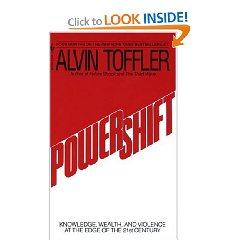
The TIME section of the book has some very interesting insights including the fact that anything that requires time, like filling in a form, or that adds time to a process through regulation, is in fact a TIME TAX that is more costly than an old money tax.
The Tofflers note that vice is globalizing faster than virtue. This is very important from a taxation and social goods perspective.
They spend a great deal of time discussing the intangible economy that consists of non-rival knowledge that can be shared and bartered; volunteer time that produces economy value (notably parents who teach their children sanitary habits, how to speak, and discipline or social IQ); and alternative forms of capital–social, moral, whatever. They point out that 60% of the value of the industrial era companies is intangible knowledge, while almost 100% of the new economy is intangible.
This entire book is an Information Operations reference. They discuss global battles to manage our minds in multiple domains–religious, cultural, economic, moral. We need to pay more attention to what filters the target audience uses to determine the truth, and what filters the hostile groups are using to try to shape the local perception of truth to fit their wishes.
The book moves on to discuss what the Tofflers call the “outside brain” or the sum aggregate of knowledge that is available for individual exploitation. By one account, this consists of 12,000 petabytes.
They then begin the heart of the book on “prosumption” and the economic and social value of what they believe can no longer be called capitalism in the traditional sense.
The authors spend a sufficient amount of time exploring the implications of information technology on knowledge creation and capitalization, to include cell phones or other microchip devices that serve simultaneously as identity devices, bank accounts, and knowledge devices (as WIRED said in one issue, point the phone and read the bar code, and see if this product will kill you or if someone else was killed or abused as part of the product's development)
Having explored the emergence of the new economy, they then return to their opening discussion of time, and point out that America's infrastructure and institutions are imploding. Our energy, transportation, health, and educational infrastructures are 50 years out of date and cannot be converted or upgraded fast enough. So we have two Americas, an old industrial era poor America, and a new knowledge age rich America. They articulate a battle raging between decay and revolutionary birth, noting that micro-cash and the Internet are empowering social entrepreneurs who use the Internet to mobilize both volunteers and contributions. Micro finance is liberating small innovators from the death knell of merchant banks and venture capitalists with old mind-sets.
I learned two big things relevant to government tax fraud. Although I knew of import-export tax fraud ($50 billion a year in false pricing, an advanced form of corporate money laundering) Major corporations and most nations are heavily engaged in barter or counter-trades (e.g. billions of dollars in vodka for equivalent value in Pepsi BUT the US corporation can manipulate the valuations). They say many corporations are now moving to a form of internal corporate money so that their subsidiaries can do off the books trades that do not require either taxation or foreign exchange transactions.
The final third of the book is an absorbing discussion of how knowledge can eliminate extreme poverty, which the authors believe is more important than closing the gap between rich and poor. They emphasize that both India and China are leap-frogging the industrial era, with India focusing on connectivity to reduce poverty as well as urbanization, while China is focusing on setting standards that will allow it to “own” future information technology architectures. Africa and Latin America are being lost to Chinese immigrants, language, trade, and aid.
The Toffler's articulate a four part anti-poverty plan that makes sense to me: 1) Use knowledge to wipe out subsistence agriculture, which is the foundation for extreme poverty. They discuss how bio-technology can impact on crop yield, include medical vaccinations, convert crops into fuel, allow precision farming which dramatically reduces water and seed and fertilization costs, and improve sales while sensing disease or other threats to the crops. 2) Empower women, as this one focus leads to advances across the board. 3) End corruption by using knowledge and technology to make it next to impossible and largely transparent–the carrot side of this is that knowledge and technology can lower costs and increase government salaries. 4) Avoid industrial poisons, e.g. do not go with chlorine and oil based industry
The book concludes with a review of China, India, Japan, and Europe as either threats (the first two) or potential disasters (the last two). The authors, while extolling the possibilities of Chinese capitalism, are careful to point out the many things that could go catastrophically wrong for China, and do a similarly balanced presentation on India.
The Tofflers come across as cheerleaders for the future, accepting of the decay and disaster that will be required to dismantle dysfunctional systems including (my observation) the U.S. Government. They see real possibilities of eliminating poverty and stabilizing the world.
If you like this book, bookmark my review page, 1000+ non-fiction books that underlie and expand on this superb work by the Tofflers.
See also, with reviews:
The Wealth of Networks: How Social Production Transforms Markets and Freedom
The Wealth of Knowledge: Intellectual Capital and the Twenty-first Century Organization
Infinite Wealth: A New World of Collaboration and Abundance in the Knowledge Era
The Fortune at the Bottom of the Pyramid: Eradicating Poverty Through Profits (Wharton School Publishing Paperbacks)
The Tao of Democracy: Using Co-Intelligence to Create a World That Works for All
Society's Breakthrough!: Releasing Essential Wisdom and Virtue in All the People
One from Many: VISA and the Rise of Chaordic Organization
Escaping the Matrix: How We the People can change the world
The Cultural Creatives: How 50 Million People Are Changing the World
Group Genius: The Creative Power of Collaboration
Collective Intelligence: Mankind's Emerging World in Cyberspace
The World Cafe: Shaping Our Futures Through Conversations That Matter
Imagine: What America Could Be in the 21st Century